
Categories
Maui Real EstatePublished July 9, 2026
What Happens if Maui Changes Vacation Rental Rules After You Buy?

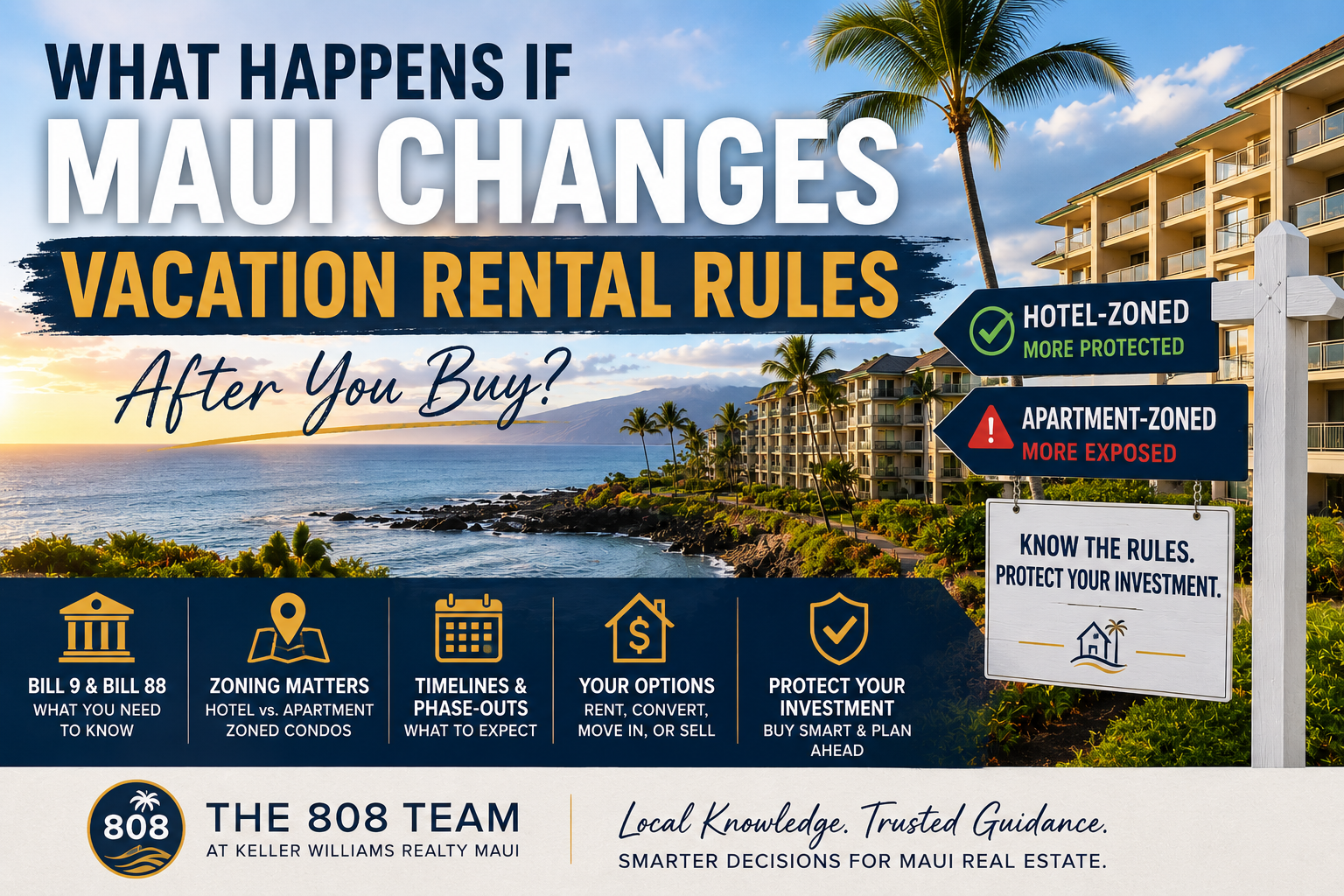
What Happens if Maui Changes Vacation Rental Rules After You Buy?
If you own or want to buy a Maui condo that depends on short-term rental income, this is one of the most important questions you can ask. So, what's going on with future rule changes, and how much risk do you actually have?
Basically, the biggest mistake I see is people treating all vacation rentals like they carry the same exposure. They do not. In Maui, your risk usually comes down to zoning, legal use status, and whether your unit sits in a protected category or an exposed one.
Key Takeaways
- Maui does not typically shut down legal vacation rental use overnight.
- Past policy changes have used multi-year amortization periods, giving owners time to adjust.
- If a property is already in a hotel, resort, business, timeshare, or other clearly permitted short-term rental category, it is generally in a more protected position.
- Apartment-zoned condos with grandfathered or nonconforming rental rights are usually the most exposed to future tightening.
- If rules change, owners often have several realistic options: keep renting during the phase-out, convert to long-term rental, move in, sell, or watch for rezoning opportunities.
- Buyers should verify zoning before closing and underwrite the property as if short-term rental income could disappear.
- Sellers and owners should treat a future deadline not as a cliff, but as a countdown.
- Bill 88 may create rezoning opportunities for some properties, but approval is not automatic.
- Lawsuits may continue, but I would not base an investment decision on a lawsuit saving the deal.
- There is no such thing as zero legislative risk in Maui, but some categories are clearly less exposed than others.
Who Should Read This Guide?
If you're thinking about buying a vacation rental on Maui, already own one, or are trying to understand how future legislation could affect your investment, this guide is for you.
Over the past couple of years, I've had countless conversations with buyers, owners, and investors who all have the same basic question:
"What happens if Maui changes the rules after I buy?"
It's a fair question, and it's one that deserves a practical answer instead of headlines or speculation.
My goal isn't to predict exactly what the County will do next because nobody can do that with certainty. Instead, I want to help you understand where the real risks are, which properties appear to be in stronger positions, and what steps you can take to protect yourself before making a purchase.
Whether you're looking at a hotel-zoned condo, an apartment-zoned property, a permitted short-term rental, or simply trying to understand how Bill 9 and Bill 88 fit into the picture, this guide will walk you through the issues that matter most so you can make a more informed decision.
Let's start with the biggest misconception I hear: people assume Maui changes vacation rental rules overnight. That's almost never how it works.
What does a Maui vacation rental rule change usually look like?
A Maui vacation rental rule change usually looks like a phase-out, not an immediate shutdown. That matters because it gives owners time to collect income, adjust strategy, and decide whether to hold, convert, or sell.
When Maui moved forward with Bill 9, operators were not cut off the next month. Instead, there was a multi-year amortization period. In general terms, some west side properties were given until 2029, and some south side properties until 2031.
That is a very different scenario than waking up and losing your income tomorrow. We're not sure what's going to happen as of yet with every future policy move, but the pattern matters: Maui has shown a willingness to use long runways rather than instant cutoffs.
What actually determines your exposure?
Your exposure is mostly determined by what you bought and how it is classified.
This is where buyers get into trouble. They focus on whether a unit has historically been rented short term, but the better question is whether that use is tied to a strong legal category or a vulnerable one.
More protected categories
In practical terms, these are generally the categories people view as more protected:
- Hotel-zoned properties
- Resort-zoned properties
- Business-zoned properties where short-term use is allowed
- Permitted B&Bs
- Permitted short-term rental homes
- Timeshares
The reason is simple. These properties were built, zoned, or formally permitted for that kind of use. They are not leaning on the same kind of legal gray area that some apartment-zoned properties have relied on.
More exposed categories
The most exposed category is usually:
- Apartment-zoned condos with grandfathered, nonconforming, or legacy short-term rental rights
That is basically the risk bucket that has drawn the most policy attention. When housing pressure rises, those are the properties most likely to be targeted first.
This is why zoning status matters more than the county's general political mood. Political sentiment can change, but zoning and legal use status tell you where your property likely stands if policy tightens again.
What happens to permitted B&B or short-term rental status when a property sells?
This is a point a lot of buyers miss. If a home has a permitted B&B or a permitted short-term rental use, that status may not automatically transfer to the next owner.
In many cases, the new owner would need to reapply legally for that use. That means buyers should never assume that because the current owner is operating legally, the next owner will inherit that same status without additional steps.
Before closing, I would always want written confirmation of:
- Current zoning
- Current legal use
- Whether the use is transferable
- Whether any permits must be reapplied for after sale
What are your options if Maui changes the rules after you buy?
If rules change, you usually have more than one path. The right option depends on your timeline, tax situation, and whether your property still works financially under a different use.
Option 1: Keep operating during the amortization period
For many owners, this is the most practical first move. If you have a legal runway of several years, keep operating the property as a short-term rental and bank that income while you still can.
If your deadline is 2029 or 2031, that gives you time to:
- Improve cash reserves
- Pay down debt
- Plan your exit
- Monitor rezoning efforts
- Decide whether conversion makes sense
This is why I tell people to think of it as a countdown, not a cliff.
Option 2: Convert to a long-term rental
Converting to long-term rental can be a very solid fallback plan. In some cases, it may also improve your tax position.
Right now, if you rent the unit long term for a year or more, you may qualify for one of the lowest property tax classifications available. In some cases, owners may also benefit from treatment closer to owner-occupant classification, including a $300,000 exemption structure tied to occupancy rules.
That can materially change the math. The monthly rent might be lower than vacation rental income, but the tax savings can help offset part of that difference.
Option 3: Move into the property as your primary residence
If the property works for your lifestyle, this can be another strong option. A full-time owner-occupant can often qualify for the best property tax rate on the island.
That can be especially attractive for owners who were already considering spending more time on Maui, retiring there, or simplifying their housing picture.
Option 4: Sell before the phase-out ends
Some owners prefer certainty and decide to sell before the deadline. That is a personal decision, but it does come with tradeoffs.
The challenge is that a phase-out usually shrinks the buyer pool. The farther a property moves into an exposed category, the more buyers start underwriting risk into the offer price. In real terms, that often means:
- More investor buyers
- More aggressive discount requests
- Fewer lifestyle buyers
- Lower pricing power
So yes, selling is an option. But sellers need to be realistic about what kind of buyer they are likely to attract.
Option 5: Watch for rezoning opportunities
As a lot of you know, Bill 88 has introduced a very important possibility. It proposes H-3 and H-4 zoning pathways, which may allow some apartment-zoned condo properties to reapply for hotel zoning.
At least it's a step in the right direction. That said, approval is not automatic.
What Bill 88 appears to do is create an opportunity to apply through an expedited path for certain complexes. It does not mean every unit on a legacy list is now permanently safe.
That distinction matters.
How should buyers protect themselves before purchasing?
If you want to reduce your risk before buying, I would follow a very simple checklist.
1. Confirm the zoning in writing
Do not rely on listing language alone. Get documentation showing whether the property is:
- Hotel zoned
- Resort zoned
- Business zoned
- Apartment zoned
- Operating under a permit
- Operating under grandfathered or nonconforming use
A good Realtor and escrow company should be able to help gather that.
2. Confirm whether the use transfers with the sale
This is especially important for B&Bs and permitted short-term rental homes. Ask directly whether the legal right is tied to the property, the permit holder, or both.
3. Underwrite the deal as a long-term rental
This is one of the best risk filters I can give you. If the property still makes sense when analyzed as a long-term rental rather than a short-term rental, you have much more protection.
If it only works with peak vacation rental income, your risk is much higher.
4. Ask whether the HOA is pursuing rezoning
If the property is in an exposed complex and the association is not pursuing H-3 or H-4 rezoning, that is important information.
Basically, if the HOA is not moving the process forward, your chances are limited. Buyers should ask:
- Is the association applying?
- What stage is it in?
- What costs are expected?
- Has legal counsel been retained?
- What owner approval is required?
5. Build the amortization deadline into your hold period
If a property has a known deadline, put that date directly into your investment model.
For example, if a unit can operate until 2031, ask:
- How much income can I realistically collect before then?
- What is my loan balance at that point?
- Would long-term rent cover the carrying costs?
- Would I sell before or after the deadline?
That is how you turn uncertainty into a plan.
Common mistakes buyers and owners make
Here are the biggest mistakes I see.
Assuming all short-term rentable condos are equal
They are not. A hotel-zoned unit and an apartment-zoned legacy-use condo are in very different risk categories.
Believing current use automatically transfers
It may not. Always verify whether permits or approvals must be reapplied for after closing.
Pricing based on best-case short-term rental income only
That can create major problems if the rules change. Stress test the deal using long-term rental numbers.
Relying on lawsuits as the plan
Owners have challenged Bill 9 on regulatory taking grounds, but no court injunction has erased the deadlines. I would plan around the current rules, not around a legal outcome that may never arrive.
Ignoring the hold-period deadline
If your legal use expires in a known year, you need to manage the property with that date in mind.
What should current owners actually do now?
If you own a legacy-use condo with a future deadline, I would keep the strategy very practical.
- Keep renting it legally while you can
- Bank income knowing you are on the clock
- Track any rezoning efforts closely
- Run the numbers on long-term conversion now, not later
- Decide in advance whether your backup plan is to sell, convert, or move in
For owners in stronger categories, such as clearly hotel-zoned properties, I would generally be much more patient. Even though pricing has softened in some areas, the long-term position of those units is still fundamentally stronger.
If I Were Buying a Maui Vacation Rental Today...
If someone asked me today whether they should still buy a Maui vacation rental, my answer would probably surprise them.
I'd tell them yes...
But only if they fully understand what they're buying.
The days of purchasing a condo because someone told you it "has always been a vacation rental" are over. Today's buyers need to dig much deeper than that.
I'd want to know exactly how the property is zoned, whether the short-term rental use is clearly permitted, whether any permits transfer with the sale, and how the numbers look if vacation rental income were reduced or even eliminated someday.
Personally, I'd be much more comfortable buying a property that was intentionally designed and zoned for visitor accommodations than one operating under a grandfathered or nonconforming use. It doesn't eliminate future legislative risk—nothing can—but it generally provides a stronger foundation.
I also wouldn't buy a property that only works financially under the absolute best-case scenario.
Real estate markets change. Interest rates change. Laws change. That's true whether you're buying on Maui or anywhere else in the country. A good investment should still make sense if conditions become less favorable than they are today.
One thing I've learned after years of helping buyers on Maui is that the people who sleep the best at night usually aren't the ones chasing the highest projected rental income.
They're the ones who understand the risks before they buy and have a backup plan if things change.
That's the approach I'd recommend.
FAQ
Will Maui ban vacation rentals overnight?
Usually, no. The more realistic pattern has been a multi-year amortization or phase-out period rather than an immediate shutdown.
Are hotel-zoned condos safe from future legislation?
Nothing is permanently immune from future law changes. But hotel-zoned and resort-zoned properties are in a much stronger practical position because short-term use is the intended use of the property.
What is the biggest risk category in Maui right now?
Apartment-zoned condos operating under grandfathered, nonconforming, or legacy short-term rental rights are generally the most exposed.
Does Bill 88 automatically fix the problem for exposed condos?
No. It may create a path to reapply for new zoning categories like H-3 or H-4, but that does not guarantee approval.
Should I buy a Maui condo based on short-term rental income?
Only if you understand the zoning and can handle the downside. Ideally, the property should still make sense if it must operate as a long-term rental.
Related Maui Real Estate Guides
If you're researching Maui vacation rentals, you may also find these guides helpful:
- Bill 9 Explained: What Every Maui Condo Owner Should Know
- Bill 88 Explained: Can It Save Maui Vacation Rentals?
- Hotel-Zoned Condos on Maui: Everything Buyers Need to Know
- Apartment-Zoned Condos on Maui: Risks, Rules & Bill 9 Explained
- How to Buy a Maui Vacation Rental Without Making an Expensive Mistake
- Maui Real Estate Market Update 2026
- Best Places to Live on Maui
- Living in Kaanapali
- Living in Wailea
Conclusion
So, what's going on with Maui vacation rental risk? The real issue is not whether rules can change. They can.
The real issue is which category your property falls into when they do.
If you own or buy in a protected category, you are in a much better position. If you own in an exposed category, the key is to plan early, treat deadlines seriously, and make decisions based on written zoning status rather than assumptions.
We will continue to monitor this event and see as it moves forward what it will look like. In the meantime, if you're buying, verify zoning first. If you're holding, build the timeline into your strategy. And if you're selling, be realistic about how buyers are pricing the risk.
Thinking About Buying or Selling on Maui?
Whether you're buying your first home, searching for a vacation property, relocating to Maui, investing in real estate, or preparing to sell, having accurate local information has never been more important.
I'd be happy to help you understand what's happening in today's market, explain how current conditions affect your specific situation, and put together a strategy that helps you achieve your real estate goals.
If you're thinking about making a move, let's have a conversation.
📱 808-344-3584
📧 Todd@The808Team.com
🌐 The808Team.com
About the Author

Todd Hudson is the founder of The 808 Team at Keller Williams Realty Maui and has helped hundreds of buyers and sellers navigate Maui's unique real estate market. Consistently ranked among Hawaii's top-producing Realtors, Todd specializes in Maui relocation, luxury homes, investment properties, vacation rentals, and helping clients understand the ever-changing Maui real estate market.
Known for his straightforward advice and in-depth market knowledge, Todd believes that educated clients make better real estate decisions. Through market updates like this one, he provides buyers, sellers, and investors with timely insights into Maui's housing trends, zoning changes, pricing, and local market conditions.
Whether you're buying, selling, investing, or simply looking for trusted advice, Todd and The 808 Team are committed to helping you make confident real estate decisions on Maui.

The 808 Team Maui
| The 808 Team | Keller Williams Realty Maui
or another way