
Categories
Move to Maui 2026Published July 4, 2026
Moving to Maui in 2026: The Complete Relocation Guide (Costs, Neighborhoods, Housing & Logistics)

Moving to Maui in 2026: The Complete Relocation Guide (Costs, Neighborhoods, Housing & Logistics)
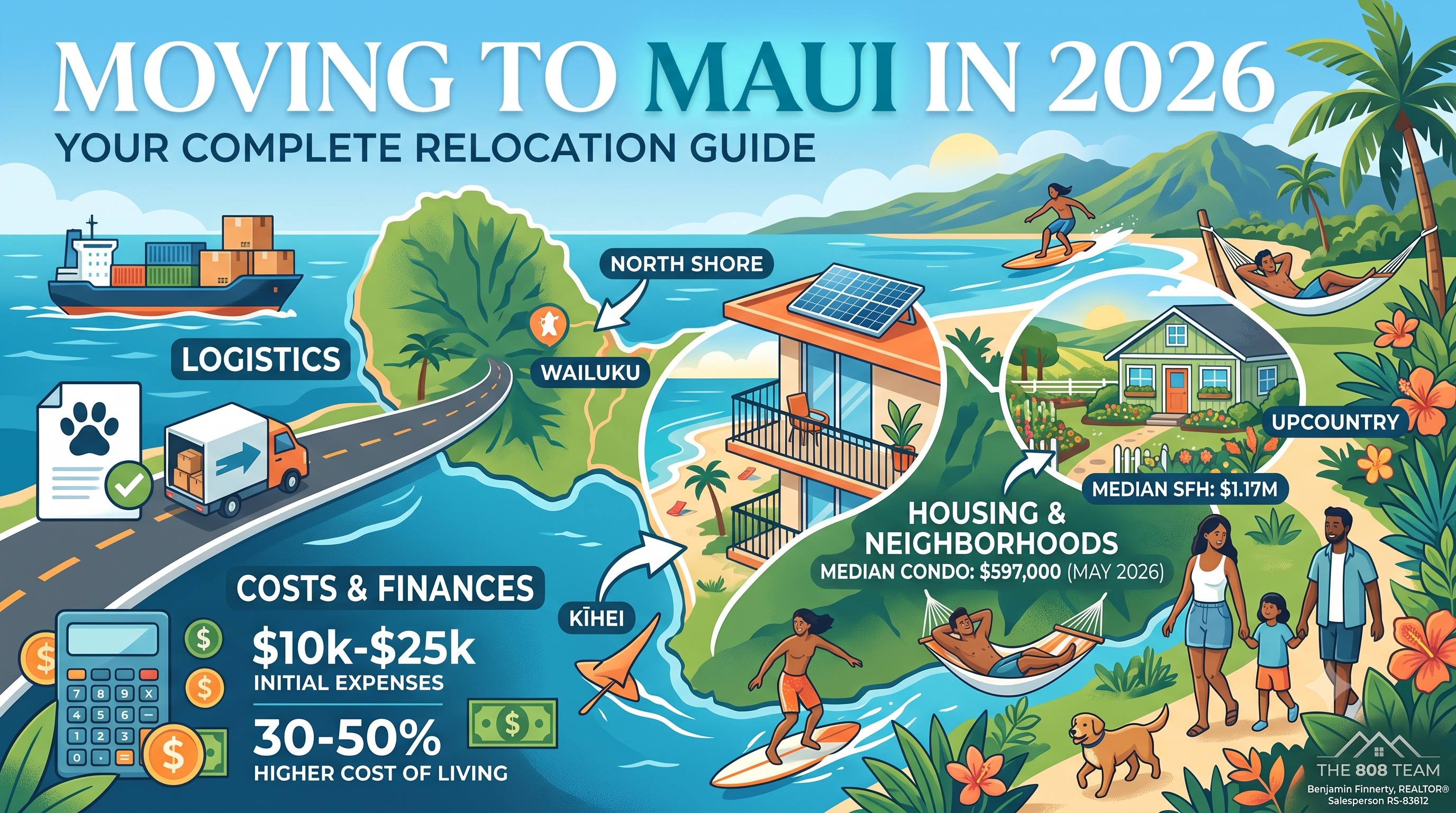
Moving to Maui in 2026 costs most mainland households $10,000–$25,000 in relocation expenses (shipping, car transport, deposits, and flights), and you should budget roughly 30–50% more for everyday living costs than the national average. The good news: after two years of price corrections, Maui housing is more accessible than it has been in years — the median condo price dropped to $597,000 in May 2026 (down more than 20% year-over-year), and single-family homes have adjusted to a median of $1,174,500. Most new residents land in Kīhei, Wailuku, Kahului, or Upcountry, and the smartest move is to rent for 6–12 months before buying so you can learn the island's micro-markets firsthand.
Is Moving to Maui Worth It in 2026?
For the right person, absolutely — but the honest answer depends on your income, your flexibility, and your expectations.
Maui offers what almost nowhere else in the United States can: year-round warm weather, world-class beaches and surf, a slower pace of life, genuine community, and outdoor living twelve months a year. People who thrive here tend to be remote workers with mainland incomes, healthcare and trade professionals (both in high demand), retirees with equity, and families who prioritize lifestyle over square footage.
The people who struggle are usually the ones who arrive without a housing plan, underestimate the cost of living, or expect Maui to function like a mainland suburb with palm trees. It doesn't. Island life means higher prices, fewer big-box conveniences, and a culture that rewards patience and humility.
Here's what's changed in 2026: for the first time in years, the housing math has shifted in favor of buyers and new arrivals. The market correction driven by short-term rental legislation and rising inventory means condos in particular are trading at prices we haven't seen since before the pandemic run-up. If Maui has been on your list, the financial barrier to entry is lower than it's been in a long time.
How Much Does It Cost to Live on Maui?
Plan for a total cost of living roughly 30–50% above the U.S. mainland average. Here's where that money actually goes:
Housing (your biggest line item)
- Long-term rental, 1-bedroom: roughly $1,800–$2,600/month depending on area and condition
- Long-term rental, 2-bedroom: roughly $2,500–$3,800/month
- Long-term rental, 3-bedroom house: roughly $3,500–$5,500+/month
- Median condo purchase price (May 2026): $597,000
- Median single-family home price (May 2026): $1,174,500
Utilities
- Electricity: Hawaiʻi has the highest electricity rates in the nation, often 3x mainland costs. A/C usage is the big variable — many longtime residents rely on trade winds and ceiling fans instead. Budget $150–$400+/month depending on your habits and whether your home has solar.
- Solar matters: homes with owned PV systems and battery storage can dramatically reduce this line item, and it's a real factor when comparing properties.
- Water/sewer, internet, and mobile service run close to mainland norms.
Groceries and dining
- Expect 30–50% higher grocery bills than the mainland. A gallon of milk can run $7–9, and everyday staples carry the shipping premium.
- Money-saving strategies locals actually use: Costco in Kahului, farmers markets (Upcountry Farmers Market on Saturdays is a favorite), buying local produce in season, and fishing/hunting if that's your lifestyle.
Transportation
- Gas typically runs $1–1.50/gallon above mainland prices.
- Most households need a car. The Maui Bus exists but coverage is limited outside central corridors.
Healthcare
- Maui Memorial Medical Center in Wailuku is the island's main hospital. Specialist care sometimes requires a flight to Oʻahu, which is a real consideration for anyone with complex medical needs. Hawaiʻi's Prepaid Health Care Act requires employers to provide health insurance to employees working 20+ hours/week — one of the most employee-friendly healthcare laws in the country.
Taxes: better than you'd think
- Hawaiʻi has some of the lowest property tax rates in the nation. Owner-occupied homes on Maui enjoy favorable rates and a homeowner exemption that meaningfully reduces your bill.
- There's no personal property tax on vehicles (beyond registration fees).
- The trade-off: state income tax is progressive and reaches into double digits for high earners, and the 4.166% general excise tax applies to nearly everything, functioning like a broad sales tax.
What Is the Maui Housing Market Like Right Now?
This is the section most relocation guides get wrong, because they're written from the mainland with stale data. Here's the current picture:
Maui's housing market has spent nearly two years correcting. The median condo price fell to $597,000 in May 2026 — down more than 20% from the year prior — driven largely by the ripple effects of short-term rental legislation (Bill 9 and the newer Bill 88 hotel-district framework) on apartment-zoned vacation rental buildings. Single-family home prices have adjusted more modestly, with the May 2026 median at $1,174,500.
What this means if you're relocating:
- Condo buyers have leverage they haven't had in years. Inventory is up, days on market have stretched past 150 days for condos, and sellers are negotiating. Units that were priced as vacation-rental investments are being repriced as residences — which is exactly what a relocating buyer wants.
- Zoning knowledge is everything. The difference between an apartment-zoned condo losing its short-term rental rights and a hotel-zoned condo that keeps them can be hundreds of thousands of dollars in value — and it determines what you can legally do with the property. If you're buying to live in the unit full-time, the STR sunset is your opportunity. If you're buying with any rental income plans, you need building-by-building guidance before you write an offer.
- Renting first is still the smart play. Maui's micro-markets behave very differently — South Maui, West Maui, Central, Upcountry, and North Shore each have their own supply dynamics. Six to twelve months on-island teaches you things no listing photos can.
Where Should I Live on Maui? Neighborhood Breakdown
Kīhei (South Maui) — Sunny, dry, and beach-centric, with more than 30 beaches and beach parks along six miles of coastline. Kīhei offers the island's widest range of condo options, a walkable stretch of restaurants and shops, and quick access to Wailea's resorts and golf. It's popular with remote workers, active retirees, and anyone whose non-negotiable is being in the water before work. This is also where the condo market correction has created the most opportunity.
Wailea & Mākena (South Maui) — Maui's luxury resort corridor: master-planned, manicured, and home to the island's most prestigious condominium communities and estates. If your budget starts north of $1.5M and you want resort-caliber amenities, this is the address.
Wailuku — The county seat and one of the island's best values for residents. Historic charm, a growing food scene, cooler temperatures at the base of the West Maui Mountains, and real-neighborhood feel. Popular with local families and first-time buyers.
Kahului — The island's commercial hub: airport, Costco, Target, big-box shopping, and the harbor. Not a resort area, but practical, central, and home to many working families.
Upcountry (Makawao, Pukalani, Kula, Haʻikū) — Cooler temperatures, pastoral views, gardens that actually grow, and more land for your money. Paniolo (Hawaiian cowboy) heritage in Makawao, misty mornings in Kula, and jungle-lush Haʻikū on the North Shore side. The trade-off is a 20–45 minute drive to the beach.
West Maui (Lahaina, Kāʻanapali, Nāpili, Kapalua) — Historically the island's other resort corridor. West Maui continues its recovery and rebuilding following the 2023 wildfires, and the community's resilience is remarkable. Housing here requires current, on-the-ground knowledge more than anywhere else on island.
Pāʻia & the North Shore — Windsurf capital, boutique-bohemian town center, and some of the island's most beautiful stretches of coast. Limited inventory and strong demand keep prices firm.
How Do I Actually Move My Stuff to Maui?
Shipping household goods Matson and Pasha Hawaii are the two main ocean carriers. Your options, roughly in ascending order of cost:
- Sell most of it and ship boxes via USPS/UPS/FedEx or air freight — the minimalist route many people swear by
- A shared or partial container through a freight consolidator
- A full 20-foot or 40-foot container: typically $5,000–$12,000+ from the West Coast depending on volume and origin Furniture is expensive to replace on-island, so run the math both ways — but remember that humidity and salt air are hard on mainland furniture anyway.
Shipping your car Matson and Pasha both ship vehicles from West Coast ports (Los Angeles, Oakland, Seattle/Tacoma) to Kahului. Budget roughly $1,500–$2,500 from the West Coast, more from inland or East Coast origins, with transit times of about 1–3 weeks. Once it arrives, you'll register the vehicle with Maui County and get a Hawaiʻi safety inspection.
Bringing pets Hawaiʻi is rabies-free and protects that status with the strictest animal quarantine rules in the country. The Direct Airport Release / 5-Day-Or-Less program lets prepared pets skip extended quarantine, but the checklist — rabies vaccinations, an OIE-FAVN blood test, waiting periods, microchip, and paperwork — takes months to complete. Start the process at least 4–6 months before your move. This is the single most common timeline mistake relocating families make.
Timing your move There's no bad season, but shipping demand peaks in summer. Booking your container and car transport 6–8 weeks ahead keeps costs down and stress low.
Can I Find Work on Maui?
Maui's economy is anchored by tourism and hospitality, but the in-demand list is broader than people assume: healthcare (chronic shortage), construction and skilled trades (amplified by West Maui rebuilding), education, and government roles all offer real opportunity. Wages in many sectors run below mainland equivalents while costs run above — which is why the fastest-growing category of new resident is the remote worker bringing a mainland salary to an island time zone.
A note for remote workers: Hawaiʻi Standard Time is 2–3 hours behind the West Coast (Hawaiʻi doesn't observe daylight saving), which means 3-6 a.m. meetings if your team is on Eastern time. Plenty of people make it work — early mornings, afternoon surf.
What Should I Know About Island Culture Before Moving?
This matters more than any line item in your budget. Maui is not a resort — it's a community with deep Hawaiian roots, multigenerational local families, and a culture built on respect, humility, and reciprocity.
- Slow down. Traffic moves slower, lines move slower, and honking is rare. "Island time" is real and it's a feature, not a bug.
- Let people merge. Wave thank you. The shaka isn't a costume; it's how the road works here.
- Learn and respect Hawaiian culture and language. Understanding words like kuleana (responsibility), mālama (to care for), and aloha ʻāina (love of the land) isn't optional extra credit — it's part of living here well.
- Give more than you take. Volunteer, support local businesses, show up for your community. Newcomers who invest in the island find the island invests back.
Moving to Maui Checklist & Timeline
6+ months out
- Start the pet import process (rabies vaccines and blood test)
- Research neighborhoods and set a realistic housing budget
- If buying: connect with a local agent to start tracking inventory and understand zoning
3–4 months out
- Secure a long-term rental or go under contract on a purchase
- Get shipping quotes (container and vehicle)
- Line up employment or confirm your remote-work arrangement
1–2 months out
- Book container and car shipping
- Transfer medical records; identify a Maui physician and dentist
- Set up Hawaiian Electric, water, and internet for your new address
After arrival
- Hawaiʻi driver's license (within 30 days if you'll be a resident driver)
- Vehicle registration and safety check with Maui County
- Register to vote, update your address everywhere
- Find your beach. You'll know it when you see it.
Frequently Asked Questions About Moving to Maui
How much money should I save before moving to Maui? A comfortable target is $15,000–$30,000 in liquid savings beyond your housing costs: enough to cover shipping, first/last/deposit on a rental, a used car or car shipping, and a 2–3 month cushion while you settle in. Buyers should add closing costs of roughly 1–3% of purchase price on top of their down payment.
Is it cheaper to rent or buy on Maui in 2026? With condo prices down more than 20% year-over-year and rents holding firm, the buy-versus-rent math has shifted meaningfully toward buying for anyone planning to stay 5+ years — especially in South Maui condo buildings where seller motivation is high. That said, renting first remains the right call for anyone who hasn't lived on-island before.
What is the cheapest area to live on Maui? Central Maui (Wailuku and Kahului) generally offers the lowest housing costs for both renters and buyers, followed by parts of Kīhei's condo market and select Upcountry pockets. "Cheap" is relative on Maui — but the 2026 correction has widened the affordable end of the market considerably.
Can I buy a condo on Maui and rent it out when I'm not there? It depends entirely on the building's zoning. Recent legislation (Bill 9 and Bill 88) is phasing out short-term rental use in apartment-zoned buildings while preserving it in hotel-zoned properties. Long-term rentals (180+ days) remain legal island-wide. Before buying with any rental plans, verify the specific building's zoning status — this is the single most consequential due-diligence item in today's market.
Do I need a car on Maui? Almost certainly yes. The Maui Bus serves central corridors, but most neighborhoods, beaches, and jobs require a vehicle. Many residents ship a car from the mainland rather than buying on-island, where used car prices carry a premium.
How long does it take to ship belongings to Maui? Ocean freight from the West Coast typically takes 1–3 weeks port-to-port, plus time on both ends for pickup and delivery. From the East Coast, plan on 3–5 weeks. Book 6–8 weeks ahead during summer peak season.
Is Maui safe from natural disasters? Maui contends with hurricane season (June–November, though direct hits are rare), flash flooding in certain drainages, and wildfire risk in dry leeward areas — a risk the island knows painfully well since 2023. Homeowners insurance, including hurricane coverage, is a required budget line and has risen in cost; factor it into any purchase analysis.
What's the biggest mistake people make when moving to Maui? Underestimating the pet import timeline and buying property without understanding zoning. The second one is expensive; the first one breaks hearts. Both are completely avoidable with early planning.
Thinking About Making the Move?
I've helped families relocate to Maui from across the mainland and internationally, and 2026 is genuinely one of the most interesting windows I've seen: more inventory, motivated sellers, and condo pricing that's rewritten the entry point to island life. Whether you're six months out or just starting to dream, I'm happy to talk through neighborhoods, current listings, zoning questions, or the honest pros and cons of your specific situation.
Benjamin Finnerty, REALTOR® Salesperson RS-83812 | The 808 Team – Keller Williams Realty Maui 380 Huku Li'i Place, Suite 201, Kīhei, HI 96753 📞 808-481-9748 ✉️ benjamin@the808team.com 🌐 benjamin.the808team.com
我们提供中文服务,欢迎联系。
This article is for informational purposes only and does not constitute legal, tax, or financial advice. Market data reflects Realtors Association of Maui statistics as of May 2026 and is subject to change. Buyers and sellers should verify all information independently and consult appropriate professionals.

The 808 Team Maui
| The 808 Team | Keller Williams Realty Maui
or another way