
Categories
Bill 9 and Bill 88Published August 21, 2026
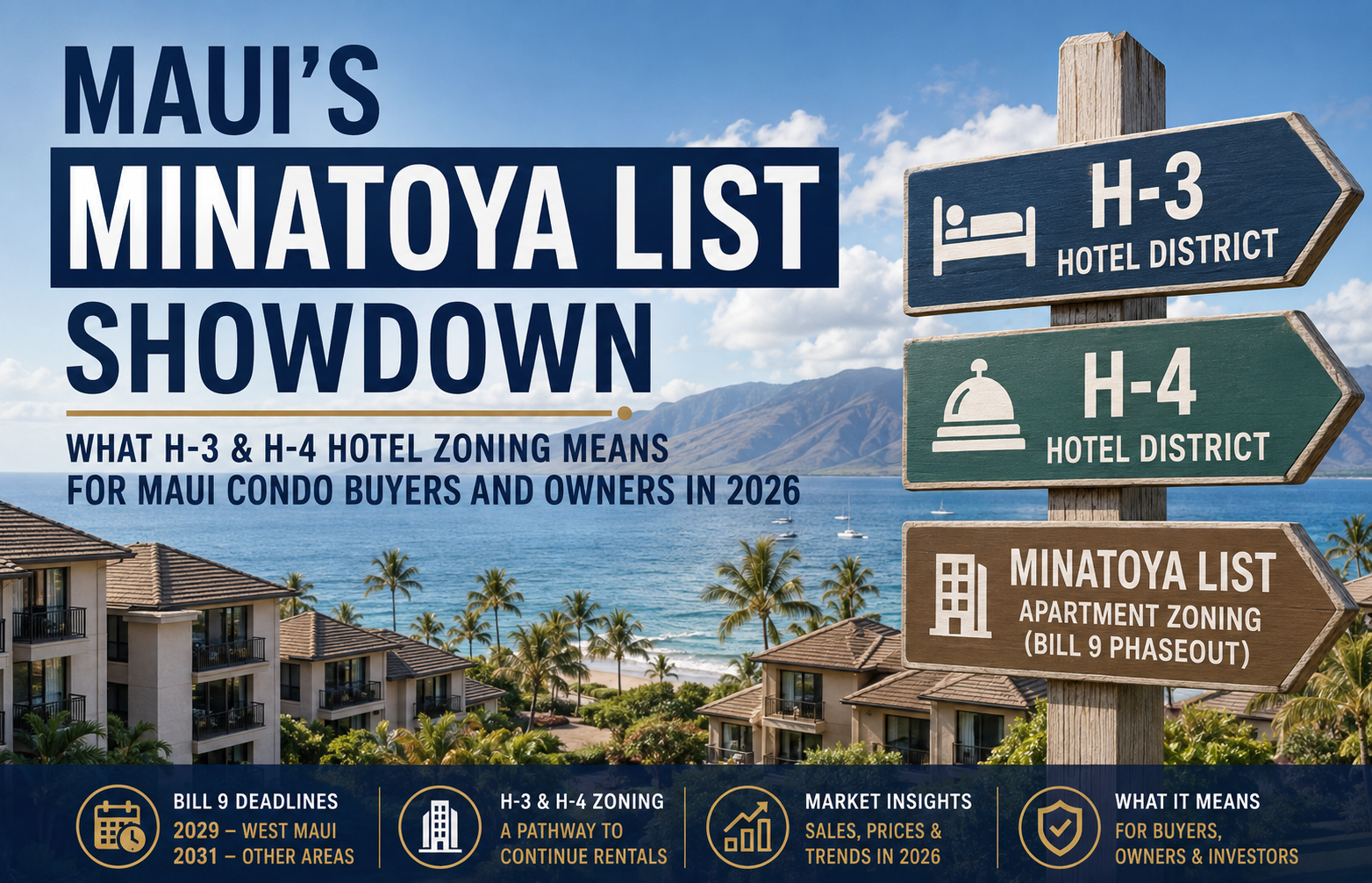
Maui’s Minatoya List Showdown: What H-3 and H-4 Hotel Zoning Means for Condo Buyers and Owners in 2026

If you're considering a condo in Kīhei, Kāʻanapali, Kahana, Nāpili, or another Maui resort area, you’ve probably heard the term “Minatoya List.”
In 2026, understanding that term has become essential.
Bill 9 is phasing out short-term vacation rental use in certain apartment-zoned Maui condominiums. At the same time, Maui County has created new H-3 and H-4 Hotel Districts that may allow some affected properties to move into hotel zoning and continue vacation rental use.
The key word is may.
Being identified for possible H-3 or H-4 zoning does not mean a condo has already been rezoned.
For Maui condo buyers and owners, the question is becoming increasingly building-specific: What is the property zoned today, is it affected by Bill 9, and where does it currently stand in Maui County’s rezoning process?
Here’s what you need to know as of August 2026.
What Is the Maui Minatoya List?
The Minatoya List is the commonly used name for Maui condominium properties that historically qualified to operate as transient vacation rentals despite being located within A-1 or A-2 Apartment Districts rather than Hotel Districts.
The name comes from a 2001 legal opinion by Maui County Deputy Corporation Counsel Richard Minatoya.
For decades, this framework allowed thousands of Maui condo units, particularly in West Maui and South Maui, to legally operate as short-term vacation rentals even though their underlying zoning was primarily residential.
That longstanding exception is what Bill 9 is now phasing out.
What Is Maui Bill 9?
Bill 9, now Ordinance 5909, phases out transient vacation rental use in affected A-1 and A-2 Apartment District properties.
Mayor Richard Bissen signed Bill 9 into law on December 15, 2025. Maui County describes the legislation as an effort to return apartment-zoned properties to residential use and increase Maui’s long-term housing supply. Maui County
Bill 9 does not ban vacation rentals throughout Maui.
Hotel-zoned properties, legally operating timeshares, properties operating under qualifying variances, and other visitor accommodations permitted by law are treated differently.
When Do Bill 9 Vacation Rentals Have to Stop?
The deadline depends on the property's location.
For affected properties within the West Maui Community Plan area, transient vacation rental use may continue through December 31, 2028, and must cease beginning January 1, 2029.
For affected properties elsewhere in Maui County, including South Maui, transient vacation rental use may continue through December 31, 2030, and must cease beginning January 1, 2031.
Those dates are established in Ordinance 5909. Maui County
For buyers, this means a condo can be producing legal nightly rental income today while facing a very different permitted use several years from now.
That future use needs to be part of the valuation.
What Are H-3 and H-4 Hotel Districts?
H-3 and H-4 are new Maui County hotel zoning classifications created in June 2026.
Maui County officially adopted the legislation establishing the two districts on June 22, 2026. Maui County
The new classifications create a potential pathway for certain apartment-zoned properties to transition into hotel zoning.
That could be extremely important for Minatoya List condo owners.
If a qualifying property ultimately receives hotel zoning, its future ability to operate transient vacation rentals could be very different from a property that remains apartment-zoned and subject to Bill 9.
Does H-3 or H-4 Zoning Automatically Save a Minatoya Condo?
No.
This is probably the most important point for buyers to understand.
Bill 88 created the H-3 and H-4 zoning categories, but it did not automatically rezone thousands of Maui condos.
A property appearing on a County list or Council resolution is not the same thing as a property that has completed the rezoning process.
Maui County is handling these properties through additional land-use actions, including Planning Commission review and eventual County Council consideration.
So when someone says, “This building is getting hotel zoning,” I would want to know exactly what that statement means.
Has it merely been recommended?
Has it been included in a Council resolution?
Has it been referred to the Planning Commission?
Has the Planning Commission made its recommendation?
Has the Council actually approved the change in zoning?
Those are very different stages.
What Happened on July 24, 2026?
On July 24, the Maui County Council voted 7–1 to advance Resolutions 26-110 and 26-111.
Together, the resolutions referred approximately 2,056 apartment-zoned transient vacation rental units to the Maui Planning Commission for consideration of potential H-3 or H-4 hotel zoning. Maui Now
Resolution 26-110 covers several categories of properties, including certain leasehold, timeshare, single-owner, and variance-related properties.
Resolution 26-111 focuses on properties the County considers to function more like hotels, based on factors such as guest services, property-wide management, housekeeping, and other hotel-like operations. Maui Real Estate Advisors
Again, these resolutions are referrals.
They are not final rezoning approvals.
That distinction matters when you are deciding what a condo is worth today.
How Many Maui Condos Could Eventually Receive H-3 or H-4 Zoning?
Mayor Bissen has supported a Temporary Investigative Group recommendation identifying 4,519 units for potential H-3 or H-4 reclassification.
But that does not mean all 4,519 units will ultimately receive hotel zoning.
The July 24 resolutions moved an initial group of roughly 2,056 units further into the review process, while additional properties may be addressed through other resolutions and amendments.
The list is still evolving.
That is why buyers should verify the current status of the specific building rather than relying on a general Minatoya List.
What Is Happening to Maui Condo Sales in 2026?
While all of this regulatory change has been unfolding, Maui condo sales have risen sharply.
In July 2026, 82 Maui condos sold, a 54.7% increase from July 2025.
The median condo sale price was $690,000, up 2.2% year over year.
That does not necessarily mean Maui condo values are suddenly surging.
Instead, the higher transaction count suggests that more buyers and sellers are finding prices at which they are willing to make deals.
Some Bill 9-affected sellers may be adjusting expectations.
Some buyers may see current pricing as an opportunity.
And other buyers are specifically targeting hotel-zoned properties or condos with stronger long-term zoning certainty.
What Does H-3 and H-4 Zoning Mean for Maui Condo Prices?
Potential hotel rezoning can materially affect how buyers perceive risk.
Imagine two similar Maui condos.
Both currently operate as vacation rentals.
One is already hotel-zoned and is not relying on the Minatoya exception.
The other is apartment-zoned, affected by Bill 9, and merely being considered for future H-3 or H-4 zoning.
Those properties may have similar rental histories today, but they do not necessarily have the same regulatory risk.
That difference can influence price.
As Maui moves through the rezoning process, I expect buyers to pay increasingly close attention to the specific legal and zoning status of individual condo complexes.
What Should You Check Before Buying a Minatoya List Condo?
Before making an offer on a Maui condo that currently operates as a vacation rental, I would want answers to the following questions:
What is the property's current zoning?
Is it A-1 or A-2 Apartment District?
Is the property affected by Bill 9?
Is its phase-out date January 1, 2029, or January 1, 2031?
Is the property included in an H-3 or H-4 rezoning proposal?
Which Maui County resolution applies?
Has it only been referred to the Planning Commission, or has the rezoning actually been approved?
Would you still want to own the property if vacation rental use eventually ended?
What would the condo likely be worth as a second home, residence, or long-term rental?
What are the HOA fees, insurance costs, reserves, assessments, and financing considerations?
For me, the most important question is still this:
Would this be a good purchase even if the rezoning never happens?
If the answer is yes, successful H-3 or H-4 zoning could represent additional upside rather than something the entire purchase depends upon.
What Should Current Minatoya Condo Owners Do?
If you already own an affected Maui condo, the first thing I would do is determine exactly where your building stands.
Find out whether your association is involved in the H-3/H-4 process.
Determine which County resolution applies to the property.
Understand whether your building is merely being considered or has actually progressed through Planning Commission and Council review.
Then consider your own objectives.
Some owners may choose to continue operating legally through the remaining Bill 9 period.
Some may sell while vacation-rental income remains available.
Others may hold and see whether their building successfully transitions into hotel zoning.
And some may eventually convert the property to personal or long-term residential use.
There is no single answer for every owner.
What If You’re Buying a Maui Condo to Live In?
If your primary goal is to live in the property rather than operate a vacation rental, Bill 9 can look very different.
Regulatory uncertainty may reduce competition from investors in certain buildings.
That can potentially create buying opportunities for people looking for a primary residence, second home, retirement property, or long-term Maui base.
But zoning still matters because it can affect financing, resale value, neighboring uses, and the future buyer pool.
So even if you never plan to rent your condo nightly, I would still want to understand its Bill 9 and H-3/H-4 status.
Is Every Maui Vacation Rental Condo Affected by Bill 9?
No.
This is another common misconception.
Bill 9 specifically targets affected transient vacation rentals located in apartment districts.
Many Maui vacation-rental condos are located in hotel or other zoning districts and are not dependent on the Minatoya framework.
That is why buyers should never assume that two vacation-rental condos have the same legal status simply because they are in the same neighborhood.
The Bottom Line on Maui’s Minatoya List and H-3/H-4 Zoning
Maui’s condo market is no longer simply divided between vacation rentals and residential condos.
It is increasingly divided by zoning certainty.
Bill 9 phases out short-term rental use in certain apartment-zoned properties beginning January 1, 2029, in West Maui and January 1, 2031, elsewhere in Maui County.
Bill 88 created H-3 and H-4 Hotel Districts that could provide a path for some affected properties to continue vacation-rental use.
And the County has now begun moving specific groups of properties through that rezoning process.
But being on a proposed rezoning list is not the same as being rezoned.
For anyone buying or selling a Maui condo in 2026, understanding the exact building may now be more important than understanding the island-wide market.
If you're considering a particular Maui condo and want to know whether it's on the Minatoya List, whether Bill 9 applies, which County resolution covers it, or where it currently stands in the H-3/H-4 process, I can help you research the specific complex and compare it with current sales.
I’m Benjamin Finnerty, REALTOR® on Maui and Director of Sales for The 808 Team. I work with buyers and sellers throughout Maui, with a particular focus on South Maui real estate, including Kīhei, Wailea, and Mākena.
Benjamin Finnerty REALTOR® RS-83812
Keller Williams Realty Maui RB-21851
This article reflects publicly available information as of August 2026 and is intended for general informational purposes only. It is not legal, tax, zoning, or investment advice. Maui County legislation, court proceedings, individual rezoning proposals, and property classifications can change.
Suggested URL slug:

The 808 Team Maui
| The 808 Team | Keller Williams Realty Maui
or another way