
Categories
Maui Real Estate InvestingPublished August 27, 2026
Are Maui Apartment-Zoned Condos Undervalued? The Zoning Opportunity Investors Are Watching

Are Maui Apartment-Zoned Condos Undervalued? The Zoning Opportunity Investors Are Watching
Maui's apartment-zoned condo market is in one of the most unusual positions I've seen in years.
On one side, there is legitimate regulatory uncertainty surrounding the future of short-term vacation rentals.
On the other, the market has already responded with some dramatic price reductions.
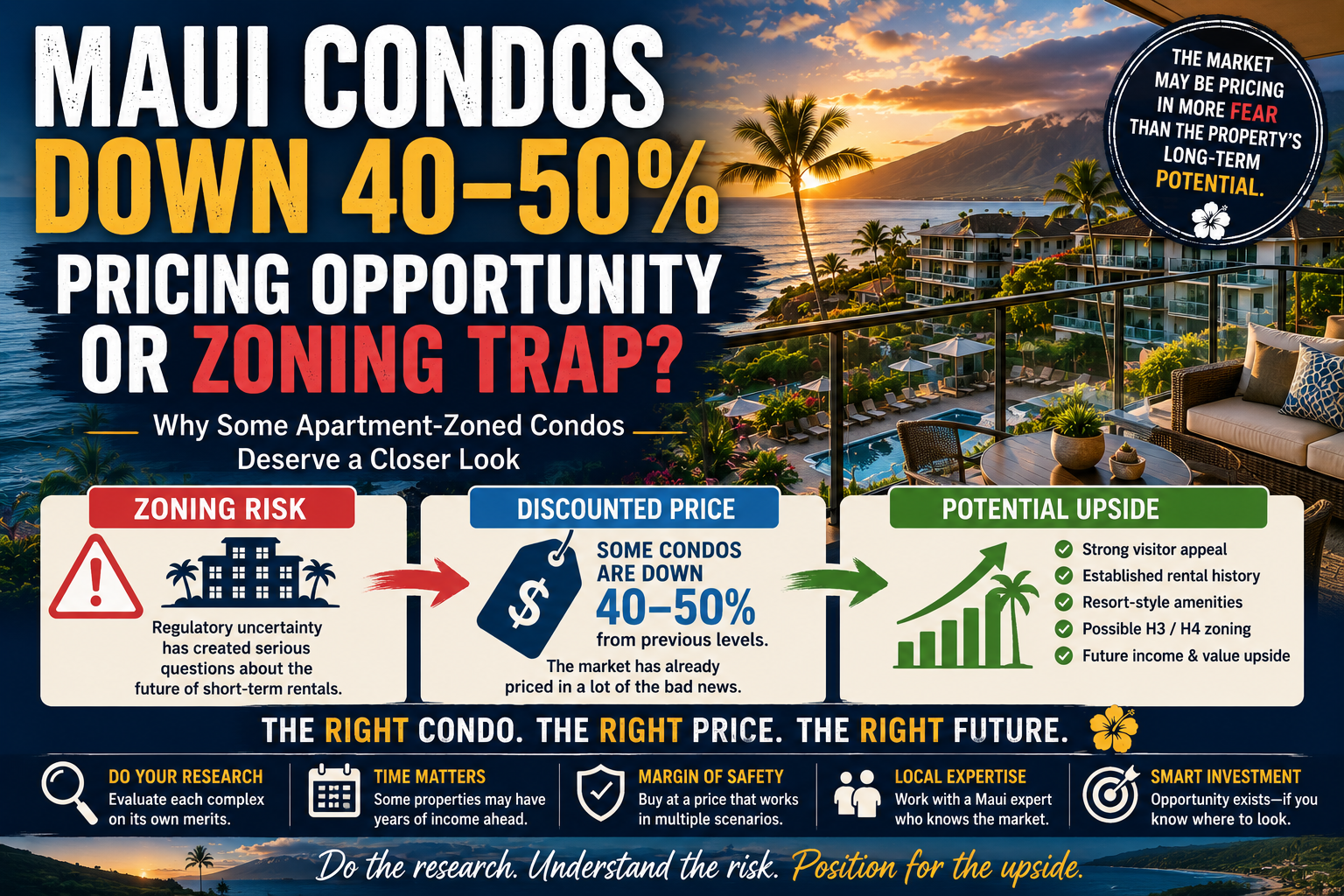
Some Maui condos that previously competed heavily in the vacation-rental market have seen values fall 40% to 50% from previous levels.
That creates a question I think every serious Maui real estate investor should be asking:
Has the market already priced in too much of the bad news?
I think the answer may be yes—but only for a very specific group of properties.
I don't believe apartment-zoned Maui condos as a whole are suddenly a screaming buy.
The potential opportunity is in the subset of properties that combine strong visitor appeal, established vacation-rental history, resort-style characteristics, attractive current pricing, and a plausible path toward greater zoning clarity.
That's a very different investment thesis.
Start With the Disconnect
The easiest way to understand what's happening is to look at the gap between a property's current price and its historical economic role.
Some Maui condos that historically operated heavily in the vacation-rental market have experienced enormous price declines.
But here's what's interesting.
The physical asset hasn't disappeared.
The beach is still there.
The location is still desirable.
The pool and resort amenities are still there.
Visitors are still coming to Maui.
And depending on the property and applicable regulations, there may still be years of rental income ahead.
What changed most dramatically wasn't necessarily the property.
It was the market's perception of what that property might be allowed to do in the future.
That's why I don't think this is simply a story about cheap Maui condos.
It's a story about regulatory uncertainty being priced into real estate values.
For a broader look at how the different segments of Maui real estate are behaving right now, read [Maui Real Estate Market 2026: What's Holding Value?]
Regulation Changed the Maui Condo Investment Equation
The debate over short-term rentals changed how buyers look at apartment-zoned Maui condos.
Properties that once traded primarily on their location and vacation-rental income potential suddenly began trading on another major variable:
Regulatory risk.
That shift can be brutal for property values.
If investors aren't confident that an asset will be allowed to continue operating the way it historically has, they're naturally going to reduce what they're willing to pay for it.
That's how you can end up with condos selling for dramatically less than they did only a few years earlier.
But regulatory environments can evolve.
And that's where the discussion around potential H3 and H4 zoning pathways becomes particularly interesting.
If you aren't familiar with the larger short-term-rental issue, I'd start with my [Maui Bill 9 and Short-Term Rental Guide] before considering one of these properties.
Why H3 and H4 Zoning Could Matter
The broader idea behind potential H3 and H4 zoning pathways is important because some apartment-zoned complexes aren't really comparable to ordinary residential condos.
Some were built around visitors.
They were marketed to visitors.
Their amenities were designed for visitors.
Their economics were heavily influenced by visitor demand.
And in some cases, they've functioned more like resort properties than traditional residential housing for decades.
If future zoning policy ultimately recognizes that distinction, some of today's pricing could eventually look very different.
But there is an enormous caveat here:
Potential zoning relief is not approved zoning relief.
Those are two very different things.
I would never recommend buying a Maui condo solely because someone says:
"Don't worry. They'll get rezoned."
That's speculation—not due diligence.
The investment needs to make sense across multiple possible outcomes.
The Hotel-Like vs. Residential Divide
I think this could eventually become one of the most important dividing lines in Maui's condo market.
Imagine two apartment-zoned properties.
Property A
It has a resort-style pool, visitor-oriented amenities, a long history of vacation rentals, strong guest demand, and a location where tourists naturally want to stay.
Property B
It functions primarily as residential housing. Most owners live there or rent long term, and only a portion of the units historically operated as vacation rentals.
Both properties may technically face regulatory questions.
But that doesn't mean they have the same long-term story.
That's why I believe future winners and losers will increasingly be determined at the individual complex level, rather than simply putting everything with apartment zoning into the same bucket.
And that's also why I wrote [Thinking About a Maui Condo Investment? Start With These 5 Questions.]
Before buying one of these properties, investors need to evaluate the property, zoning, price, income and downside separately.
Which Maui Condo Complexes Are Worth Watching?
Among the complexes that have been part of the broader rezoning and fast-track discussion are:
- Honokai
- Lauloa Maalaea
- Maalaea Kai
- Milowai Maalaea
- Maui Sunset
- Hale Mahina Beach Resort
- Paki Maui
- Maui Sands
- Kaanapali Royale
- Kanai A Nalu
- Wailea Ekahi
- Wailea Ekolu
- Palms at Wailea
- Mahina Surf
- Papakea
- Maui Eldorado
- Kamaole Sands
- Luana Kai
- Maui Hill
- Kahana Outrigger
- Kuleana
- Kahana Village
I'd also continue watching properties such as Maui Kamaole and Maui Vista because of their established visitor-oriented characteristics and historical rental activity.
But I want to be very clear about something:
A watchlist is not a buy list.
Being discussed as part of a potential zoning solution doesn't guarantee a particular outcome.
Every complex—and every individual unit—still needs to be analyzed independently.
What Happens If the Zoning Doesn't Change?
This is where I think investors need to get away from the headlines and start looking at the actual numbers.
A property doesn't necessarily go from:
Vacation rental → zero income
overnight.
Depending on the specific property and applicable rules, there may be a transition period.
Different timelines have been discussed for certain affected properties in West Maui and South Maui.
That potential income runway can materially change the investment calculation.
Imagine purchasing a heavily discounted condo today.
If that property can generate meaningful income for several years while the regulatory process continues, you aren't simply betting everything on a future zoning decision.
You're also buying time.
And time has value when your entry price is low enough.
However, never assume that a timeline you've heard about applies universally. Verify the rules, zoning, and potential transition period for the specific property you're considering.
Now Consider the Upside Scenario
Let's look at the other side.
Suppose a property maintains visitor use or eventually moves into a zoning category that better reflects its historical use.
The market may eventually stop treating that condo like a distressed residential property.
Now you potentially have two sources of upside:
Income upside from continued vacation-rental operations.
And:
Value upside if some of the regulatory discount disappears.
That's the asymmetry investors are looking for.
The important question isn't whether that favorable outcome is possible.
The question is:
Is the probability of that outcome high enough relative to the price you're paying today?
Maui Vista Shows Why Investors Are Paying Attention
Maui Vista is an interesting example of the type of pricing disconnect that gets my attention.
One-bedroom units have traded around the mid-$300,000 range in some cases.
Historically, similar units have generated meaningful gross vacation-rental revenue, with figures around $50,000 to $60,000 annually cited during certain periods.
Now, don't take that number and plug $60,000 into your spreadsheet as current net income.
That's not how I would underwrite it.
Gross revenue isn't profit.
You still have HOA dues, management, insurance, taxes, utilities, maintenance, furnishings, vacancy and other expenses.
But historical rental performance gives us context.
When an asset that historically generated meaningful vacation-rental revenue suddenly trades at a price much closer to an ordinary residential condo, I want to know why.
Maybe the discount is completely justified.
Or maybe the market has overcorrected.
That's the research opportunity.
Where I Would Be More Cautious
I'd be more cautious with properties that have a stronger residential identity and a weaker hospitality story.
Examples that have raised more questions in the broader discussion include:
- Pacific Shores
- Kihei Garden Estates
- Grand Champions
- Kahala Kai
- Village by the Sea
That doesn't mean these are bad properties.
And it certainly doesn't mean they can't be good purchases for the right buyer.
The issue is use compatibility.
If a complex looks and functions primarily like residential housing, making the case for long-term visitor-oriented treatment may be different from a property that has operated like a resort for decades.
That's an important distinction for an investor.
What Could Maui's Condo Market Look Like in 5 to 10 Years?
I see several potential outcomes.
Scenario One: Regulatory Clarity
A group of hotel-like apartment-zoned properties receives favorable zoning treatment or greater certainty around continued visitor use.
The regulatory discount begins to shrink.
Buyer confidence returns.
Values potentially recover.
Scenario Two: A Split Maui Condo Market
Some complexes successfully preserve visitor-oriented use while others transition toward residential use.
I actually think this could be one of the most interesting outcomes.
If this happens, property selection becomes incredibly important.
You could have two apartment-zoned condos located relatively close to one another with completely different values because their legal uses and future income potential are different.
Scenario Three: Broader Restrictions
More properties lose short-term-rental viability than investors currently expect.
Income potential declines.
Values remain under pressure.
Some properties increasingly trade based on residential or long-term-rental economics.
That's why conservative underwriting matters.
Don't Ask: "Will This Condo Get Rezoned?"
I think that's the wrong question.
It's too binary.
A better question is:
"How much am I paying today for each possible future?"
If a condo is priced as though it will definitely lose its vacation-rental economics, but there is a reasonable possibility it retains or regains visitor-oriented use, the risk-reward could be attractive.
But if you're paying a price that already assumes favorable zoning is guaranteed?
The opportunity may already be gone.
Price matters.
Probability matters.
Time matters.
Income matters.
That's the investment equation.
Run the Three-Scenario Test
This is the same framework I use when thinking about these properties.
Best Case
Short-term rental operations continue and the property receives favorable zoning treatment.
What could the property be worth?
What could the income look like?
Middle Case
The property generates vacation-rental income for a period of time but eventually transitions to another permitted use.
Does your investment still make sense?
Downside Case
The desired zoning outcome never happens and the condo ultimately relies on residential or long-term-rental economics.
Would you still be comfortable owning it?
If the deal only works under the best-case scenario, that's not enough margin of safety for me.
For a deeper look at that framework, read [Thinking About a Maui Condo Investment? Start With These 5 Questions.]
The Four Things I'd Watch Most Closely
If I were tracking this segment of the Maui condo market over the next several years, I'd focus heavily on four things.
1. Zoning Progress
Which complexes are moving from discussion toward actual decisions or approvals?
2. Transaction Prices
Are buyers beginning to pay premiums for complexes perceived to have stronger future zoning prospects?
3. Rental Performance
Does visitor demand continue supporting attractive rental economics?
4. Investor Sentiment
When regulatory fear begins to fade, which properties recover first?
Those four signals could tell us a lot about where this market is heading.
Why This Could Become a Significant Maui Investment Opportunity
Some of the best real estate opportunities happen when three things occur simultaneously:
A good asset gets discounted.
The reason for the discount is understandable.
And the market isn't certain how the story ends.
That's essentially what I see happening with select Maui apartment-zoned condos.
There's enough uncertainty to keep many buyers away.
But there may also be enough underlying value to reward investors who are willing to do the research.
That's very different from blindly buying something because it's down 50%.
The Biggest Mistake Investors Can Make
Don't confuse a large discount with a large margin of safety.
A property can fall 50% and still be overpriced if its economic potential has fallen even further.
I'm not looking for the condo that has fallen the most.
I'm looking for the property where the current discount appears larger than the realistic long-term risk.
That's a much higher standard.
My Bottom Line
I wouldn't tell someone to buy an apartment-zoned Maui condo simply because it's down 40% or 50%.
That's not an investment strategy.
I'd tell an investor to look for properties where today's price may reflect more regulatory fear than the property's realistic long-term risk.
That means studying the complex—not just the unit.
Understand its visitor history.
Analyze the amenities.
Review the HOA financials.
Understand insurance and potential assessments.
Follow the zoning process.
Analyze historical and realistic future rental income.
Underwrite both short-term and long-term scenarios.
And most importantly:
Pay a price that gives you room to be wrong.
Maui's apartment-zoned condo market isn't a simple "buy" or "don't buy" story.
It's becoming a story of separation.
Some properties may struggle.
Others may adapt.
And a select group could eventually emerge from this period with much clearer positioning—and potentially significantly higher values than today's market suggests.
That's why this is one segment of Maui real estate I'm watching very closely.
Want to Know Which Maui Condos I'm Watching?
I don't believe every apartment-zoned condo on Maui is an opportunity.
But I do believe this market may be mispricing some of them.
The properties that interest me are the ones where today's price may reflect more regulatory fear than the property's realistic long-term risk—especially complexes with strong visitor demand, resort-style amenities, established vacation-rental history, and a credible path toward greater zoning clarity.
That's where you have to dig deeper than the listing price.
I'm looking at zoning, historical rental performance, HOA financials, insurance, assessments, visitor demand, potential zoning pathways, long-term rental value, and what the property could be worth under multiple future scenarios.
If you're considering buying one of these Maui condos, let's look at the numbers together before you make an offer.

Todd Hudson | The 808 Team
Keller Williams Realty Maui
📞 808-344-3584
✉️ Todd@the808team.com
Want to know which Maui condo complexes I'm watching right now?
Reach out to me. I'll help you separate the properties that are simply cheap from the ones that may actually be undervalued.

The 808 Team Maui
| The 808 Team | Keller Williams Realty Maui
or another way