
Categories
Maui Real Estate InvestingPublished August 24, 2026
When Everyone Runs From Risk, Where Do Smart Investors Look?

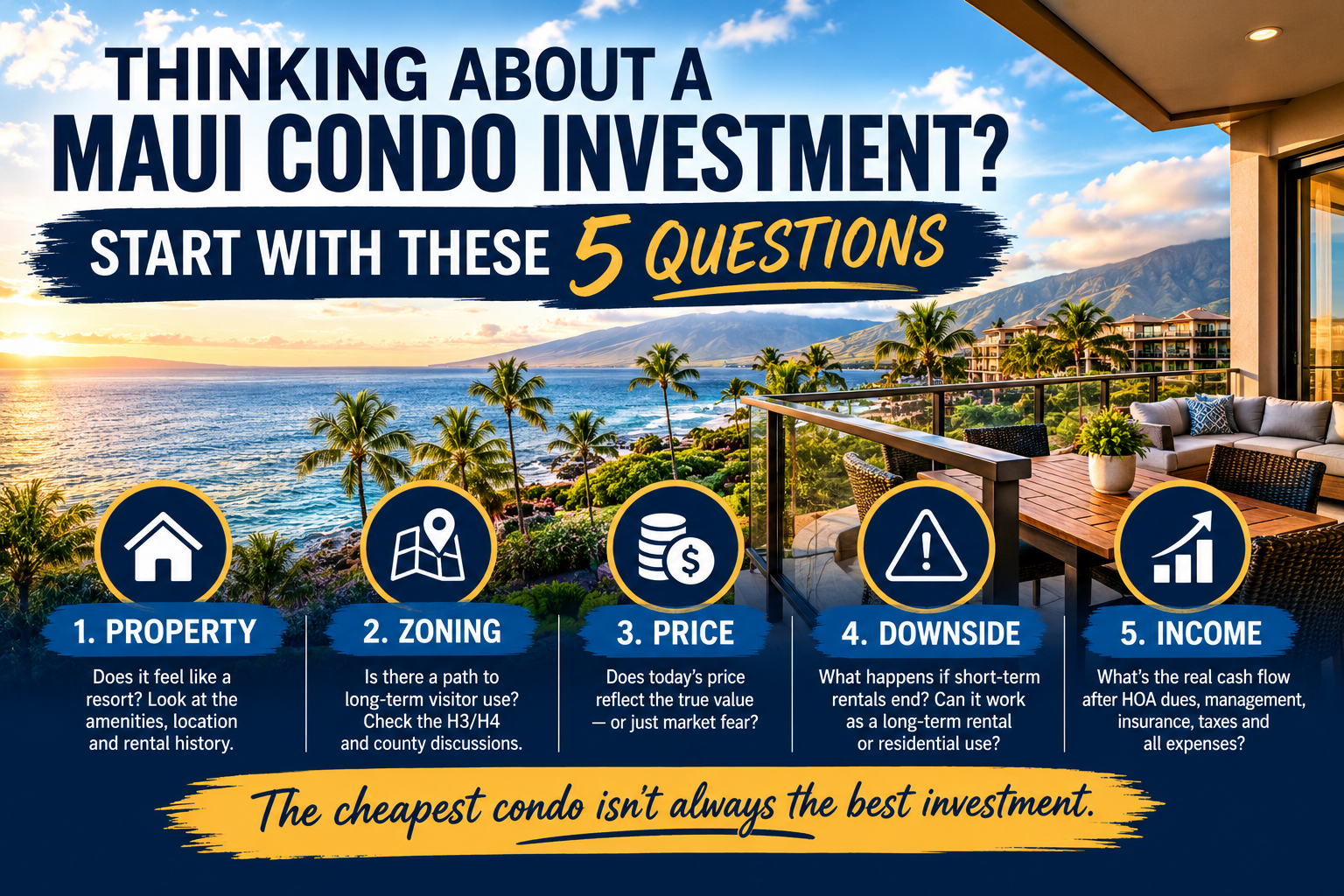
Thinking About a Maui Condo Investment? Start With These 5 Questions.
Buying a Maui condo right now requires more than looking at the list price.
Especially if you’re considering a property in an apartment-zoned complex with a history of short-term rentals.
There are some unusually low prices in this segment of the market. But low price does not automatically equal good investment.
The real opportunity is finding the properties where today’s price reflects more fear than the property’s realistic long-term potential.
That’s why I would approach this market as a selection exercise rather than a broad buying opportunity.
First, Understand What You’re Buying
Apartment-zone condos are properties located within apartment-zoned areas that have, in many cases, historically operated as short-term vacation rentals.
That history is important.
For years, some of these properties functioned almost entirely as visitor accommodations.
Then regulatory pressure changed the investment equation.
The market began asking a new question:
What happens if these properties can no longer operate as vacation rentals?
That question caused significant repricing.
For some properties, values have fallen 40% to 50% from previous levels.
But that doesn’t tell us whether the property is a bargain.
It only tells us that the market is assigning a much lower value to its future income potential.
Question #1: Does the Property Actually Feel Like a Resort?
This is the first test I would use.
Forget the listing description for a moment.
Imagine you’re a traveler arriving for a week in Maui.
Does the property feel like somewhere a visitor would naturally want to stay?
Look for things such as:
* Resort-style pools and amenities
* Beach proximity
* Visitor-oriented locations
* Established vacation-rental infrastructure
* Hospitality-style layouts
* A long history of serving visitors
* Strong guest demand
The more those characteristics exist, the more compelling the property becomes.
A residential-feeling complex with occasional vacation rentals is a very different investment proposition.
Question #2: What Is the Real Zoning Story?
This is where the research gets more complicated.
Potential H3 and H4 zoning pathways have become an important part of the discussion because they could give certain properties a route toward a more durable hotel-style or visitor-oriented use.
But don’t stop at:
“Someone said this property could be rezoned.”
That’s not due diligence.
You need to investigate the specific complex.
Ask:
* Has it been included in county discussions?
* Is there an applicable fast-track process?
* What proposed zoning category would apply?
* Does the property’s existing use fit the intended framework?
* What approvals would still be required?
* What happens if the process takes longer than expected?
The difference between “possible” and “probable” can be worth hundreds of thousands of dollars.
Question #3: Does the Current Price Give You a Margin of Safety?
This is where I think the market gets particularly interesting.
Imagine two condos.
One is a standard residential condo selling for $350,000.
The other is also selling around $350,000 but has:
* Resort amenities
* A strong visitor location
* Historical short-term rental income
* Established guest demand
* A potential zoning pathway
Why are they priced similarly?
Maybe there is a very good reason.
Or maybe the market has become so focused on regulatory risk that it has stopped properly differentiating between properties.
That’s the question I want to answer.
Question #4: What Happens If Short-Term Rentals Eventually End?
Never buy one of these properties assuming the best-case scenario.
Build the opposite scenario first.
What happens if the property loses short-term rental eligibility?
Can the unit work as a long-term rental?
Would you still want to own the property?
How much income could be earned before a transition?
What would the property be worth under residential use?
Depending on the location and applicable rules, some properties may have several years of operating income before restrictions take effect. West Maui and South Maui have had different timelines discussed, including approximately January 2029 and January 2031 for certain affected properties.
But those timelines should never be treated as universal.
The exact property matters.
Question #5: Is the Income Story Actually Good?
This is another area where investors can get themselves into trouble.
You may see a condo that previously produced $50,000 or $60,000 in gross annual rental revenue.
That sounds fantastic.
But gross revenue isn’t cash flow.
Subtract:
* HOA dues
* Property management
* Insurance
* Maintenance
* Taxes
* Utilities
* Repairs
* Vacancy
* Furnishings
* Other operating expenses
Then ask what remains.
That’s the number that belongs in your investment analysis.
Why Maui Vista Gets Investors’ Attention
Maui Vista is a good example of why this category deserves investigation.
One-bedroom units have been trading around the mid-$300,000 range in some cases.
Historically, similar units have generated significant vacation-rental revenue, with some reports of gross annual income around $50,000 to $60,000 before the market disruption.
Again, that is not a promise of future performance.
It’s simply evidence that the relationship between purchase price and historical income has changed dramatically.
And whenever that relationship changes that much, I want to understand why.
Which Properties Would I Put on the Research List?
I would begin with complexes that have a strong hospitality identity and have been part of discussions surrounding potential zoning treatment.
Examples include:
* Honokai
* Lauloa Maalaea
* Maalaea Kai
* Milowai Maalaea
* Maui Sunset
* Hale Mahina Beach Resort
* Paki Maui
* Maui Sands
* Kaanapali Royale
* Kanai A Nalu
* Wailea Ekahi
* Wailea Ekolu
* Palms at Wailea
* Mahina Surf
* Papakea
* Maui Eldorado
* Kamaole Sands
* Luana Kai
* Maui Hill
* Kahana Outrigger
* Kuleana
* Kahana Village
I’d also keep an eye on properties that could become part of future zoning or fast-track discussions.
But a watchlist isn’t a buy list.
Every individual property still needs to be evaluated.
Which Properties Would Make Me More Cautious?
I would pay closer attention to properties that have a stronger residential identity.
Examples that have raised questions in this broader discussion include:
* Pacific Shores
* Kihei Garden Estates
* Grand Champions
* Kahala Kai
* Village by the Sea
Again, this isn’t a statement that these properties are bad.
It’s simply a reminder that a property with weaker alignment to hospitality use may have a different regulatory outlook.
The Three-Scenario Test
Before buying, I’d run three versions of the investment.
Scenario A: Best Case
Short-term rental operations continue and the property receives favorable zoning treatment.
What could the property be worth?
Scenario B: Middle Case
You receive rental income for several years, but eventually the property transitions to another permitted use.
Does the investment still make sense?
Scenario C: Downside Case
The desired zoning outcome doesn’t happen and the property ultimately relies on residential or long-term rental value.
Would you still be comfortable owning it?
This exercise is incredibly useful because it takes emotion out of the decision.
The Biggest Trap
Don’t confuse a large discount with a large margin of safety.
A property can fall 50% and still be overpriced if its future income potential falls even further.
The goal isn’t to buy something that has fallen the most.
The goal is to find an asset where the current price is low relative to several reasonable future outcomes.
That’s a much higher bar.
Who Should Be Looking at These Properties?
This strategy may make sense for investors who:
* Have a longer holding period
* Understand Maui’s regulatory environment
* Can tolerate uncertainty
* Are comfortable analyzing individual condo complexes
* Can underwrite multiple scenarios
* Are willing to walk away from a bad deal
It is less suitable for investors who need a highly predictable income stream or immediate certainty around future property use.
Final Checklist
Before making an offer, I would want answers to these questions:
Property: Does it function like a hospitality asset?
Zoning: Is there a credible path toward long-term visitor use?
Price: Is today’s discount large enough to compensate for the uncertainty?
Income: What does the property actually net after expenses?
Downside: Does the investment still work if short-term rental use eventually ends?
HOA: Are the association’s finances, insurance, reserves, and assessments healthy?
Exit: Who would want to buy this property from me in five or ten years?
If you can’t answer those questions, you’re not ready to buy.
The Bottom Line
I don’t think the opportunity in Maui’s apartment-zone condo market is about finding the cheapest property.
It’s about finding the property where the risk is already reflected in the price, while the upside hasn’t been fully recognized.
That requires patience.
It requires research.
And it requires being selective.
But for the right investor, this segment of Maui real estate could offer a rare combination: deeply discounted entry pricing, potential rental income, resort-style assets, and a possible path toward greater zoning clarity.
Thinking About Investing in a Maui Condo?
There are opportunities in the Maui condo market right now that we haven't seen in years—but cheap doesn't automatically mean a good investment.
The properties I'm watching aren't necessarily the ones that have fallen the most. I'm looking for condos where the market may be pricing in more regulatory fear than the property's long-term potential justifies.
That means digging into zoning, historical rental performance, HOA financials, insurance, assessments, operating expenses, potential zoning pathways, and what the property could be worth if short-term rental rules change.
If you're considering a Maui condo as an investment, call me before you buy it.
I'll help you look beyond the listing price and run the property through the same questions I'd ask if I were considering the investment myself—including the upside, the middle case, and the downside.

Todd Hudson | The 808 Team
Keller Williams Realty Maui
📞 808-344-3584
✉️ Todd@the808team.com
Want to know which Maui condos I'm watching right now? Reach out to me and let's talk about your investment strategy.

The 808 Team Maui
| The 808 Team | Keller Williams Realty Maui
or another way