
Categories
Bill 9 and Bill 88Published August 25, 2026
Is Your Maui Condo on the New Hotel Rezoning List? Here's What Changed Before the August 27 Council Hearing

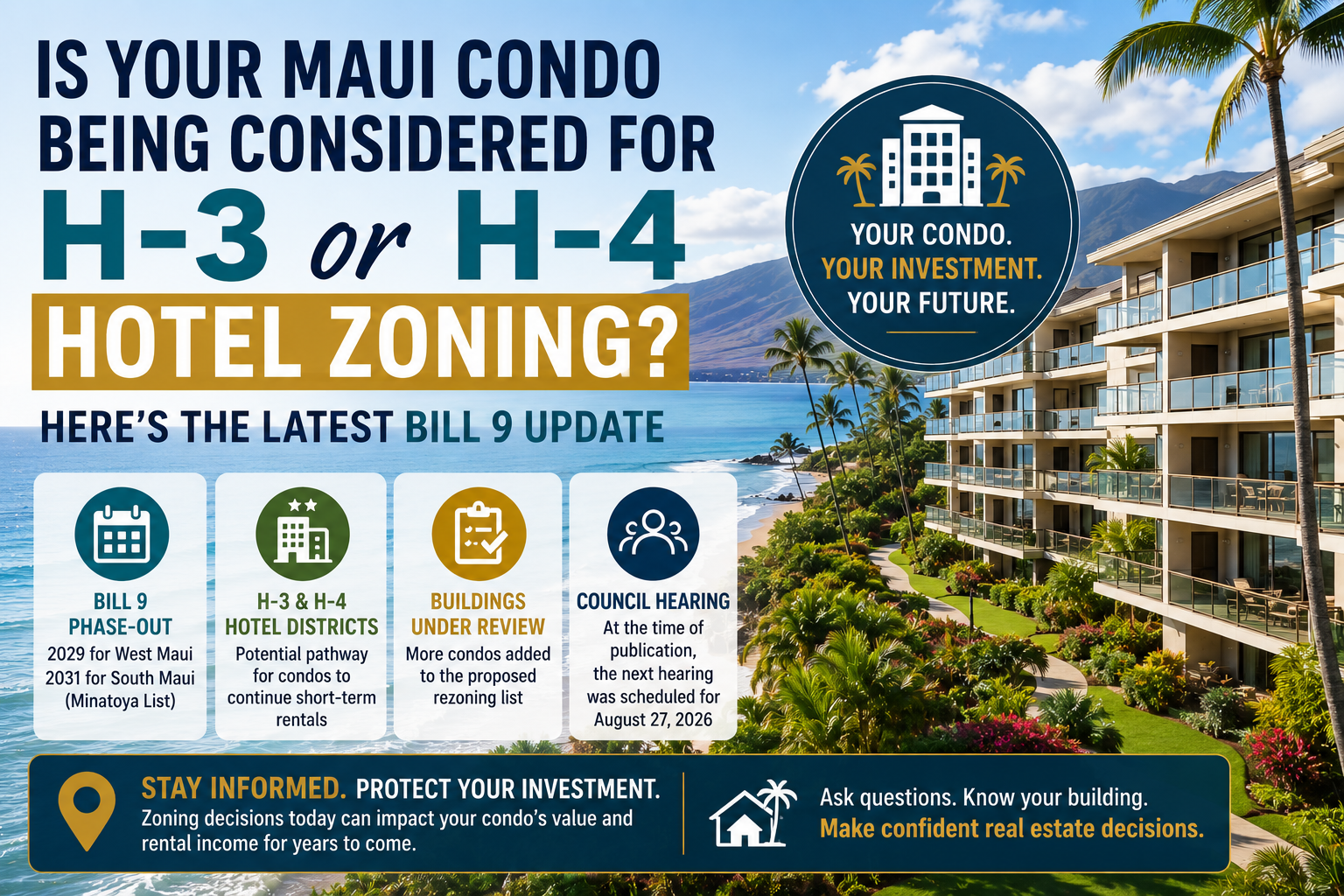
Is Your Maui Condo Being Considered for H-3 or H-4 Hotel Zoning? Here’s the Latest Bill 9 Update
If you own—or you’re thinking about buying—a vacation rental condo in Kīhei, Wailea, Māʻalaea, Kāʻanapali, Kahana, or Nāpili, there’s an important question you should be asking:
Is this building being considered for H-3 or H-4 hotel zoning?
That answer could have a significant impact on the property’s future use, potential rental income, and long-term value.
Maui County continues working through the Bill 9 implementation process, and additional condominium complexes are being proposed for consideration under the County’s new H-3 and H-4 Hotel Districts.
Here’s where things stand as of late August 2026.
Why Is This Happening?
In December 2025, Maui County adopted Bill 9, now Ordinance 5909.
The ordinance phases out transient vacation rental use in certain apartment-zoned condominium properties commonly known as the Minatoya List.
For affected properties:
- West Maui vacation-rental use must end beginning January 1, 2029.
- South Maui and the remainder of Maui County must end vacation-rental use beginning January 1, 2031.
The goal is to return apartment-zoned housing to long-term residential use while helping address Maui’s housing shortage.
However, Bill 9 isn’t the only major piece of legislation affecting these properties.
What Are H-3 and H-4 Hotel Districts?
In June 2026, Maui County adopted Bill 88, now Ordinance 6008.
The legislation created two new hotel zoning classifications:
- H-3 Hotel District
- H-4 Hotel District
These zoning districts create a potential pathway for certain apartment-zoned condominium properties to transition into hotel zoning.
If a property ultimately receives H-3 or H-4 zoning, it may continue operating as a transient vacation rental beyond the Bill 9 deadlines.
However, one point cannot be emphasized enough:
Being considered for H-3 or H-4 zoning is not the same thing as receiving H-3 or H-4 zoning.
Every property must still move through Maui County’s review process before any zoning change becomes final.
What Has the County Been Doing?
Throughout the summer of 2026, the Maui County Council’s Housing and Land Use Committee has continued reviewing additional condominium properties for possible inclusion in the H-3 and H-4 rezoning process.
The Council has been working through multiple resolutions, including Resolutions 26-129 and 26-130, while considering numerous amendments that would add additional condominium complexes.
Among the buildings proposed in various amendments are:
- Makani A Kai
- Maalaea Banyans
- Kamaole One
- Kahana Reef
- Nohonani
- Makani Sands
- Hoyochi Nikko
- Noelani
- Puunoa Beach Estates
- Kihei Resort
- Waiohuli Beach Hale
- Shores of Maui
- Polynesian Shores
- Lahaina Roads
- Kihei Parkshore
- Kaleialoha
Other properties have also requested inclusion or have been discussed during earlier hearings.
It’s important to remember that these are proposed additions under consideration.
None of these proposals automatically changes the zoning of any property.
What Happens Next?
At the time this article was published, the Housing and Land Use Committee was scheduled to continue reviewing public testimony and proposed amendments before forwarding recommendations through the County’s land-use process.
After committee review, properties must still proceed through additional Planning Commission and County Council review before any rezoning becomes effective.
In other words:
There are still several important steps remaining before any property officially becomes H-3 or H-4.
Why Does This Matter for Buyers?
If you’re purchasing a Maui condominium today, understanding the building’s current and potential zoning has become an essential part of due diligence.
Two nearly identical condominiums can have very different futures.
One property may already be hotel-zoned.
Another may be apartment-zoned but currently being considered for H-3 or H-4.
A third may remain fully subject to Bill 9 with no proposed rezoning at all.
Those differences can influence:
- future vacation-rental rights
- financing
- buyer demand
- investment potential
- long-term appreciation
- resale value
That’s why I encourage buyers to research zoning before writing an offer—not afterward.
What Does This Mean for Current Owners?
If you already own a condominium that’s affected by Bill 9, understanding where your building stands in the County process is increasingly important.
Questions worth asking include:
- Is my building included in one of the current County resolutions?
- Has it been proposed through a Council amendment?
- Has it been referred to the Planning Commission?
- Has any rezoning actually been approved?
- Is my HOA participating in the process?
The answers can help owners make more informed decisions about holding, selling, or planning for future use.
Does Being on the List Mean My Condo Has Been Rezoned?
No.
This is probably the biggest misconception surrounding the process.
Being included in a proposed amendment or County resolution does not change a property’s zoning.
It simply means the property is being considered.
The full County review process must still be completed before any zoning changes become effective.
Why Every Building Should Be Evaluated Individually
One of the biggest lessons from Bill 9 has been that broad headlines don’t tell the full story.
Today, two condos in the same neighborhood can have completely different regulatory outlooks.
Some buildings are already hotel-zoned.
Some are being considered for H-3 or H-4.
Some remain fully subject to Bill 9.
Others may never pursue hotel zoning at all.
That makes building-specific research more valuable than ever.
The Bottom Line
Every Maui condominium is now on its own path.
Some buildings are already moving through the H-3 and H-4 process.
Others remain fully subject to Bill 9.
Some may ultimately receive hotel zoning.
Others may continue toward the 2029 or 2031 phase-out dates established under Bill 9.
For buyers and owners alike, understanding the specific building—not simply the broader market—is becoming one of the most important parts of making an informed real estate decision.
If you’re considering a specific condominium, I’d be happy to help you determine:
- whether it’s affected by Bill 9
- whether it’s on the Minatoya List
- whether it’s included in an H-3 or H-4 proposal
- where it currently stands in the County review process
- and how recent sales compare within that complex.
Understanding those details before buying—or before listing your property—can make a significant difference.
I’m Benjamin Finnerty, REALTOR® on Maui and Director of Sales for The 808 Team. I work with buyers and sellers throughout Maui, with a particular focus on South Maui real estate, including Kīhei, Wailea, and Mākena.
Benjamin Finnerty REALTOR® RS-83812
Keller Williams Realty Maui RB-21851
This article is intended for general informational purposes only and should not be considered legal, tax, zoning, or investment advice. Maui County legislation, rezoning proposals, and individual property classifications continue to evolve. Buyers and sellers should verify current information before making real estate decisions.

The 808 Team Maui
| The 808 Team | Keller Williams Realty Maui
or another way