
Categories
Financing a Maui home purchasePublished August 24, 2026
Financing a Maui Condo in 2026: What New Fannie Mae Rules, Insurance Costs, and HOA Requirements Mean for Buyers

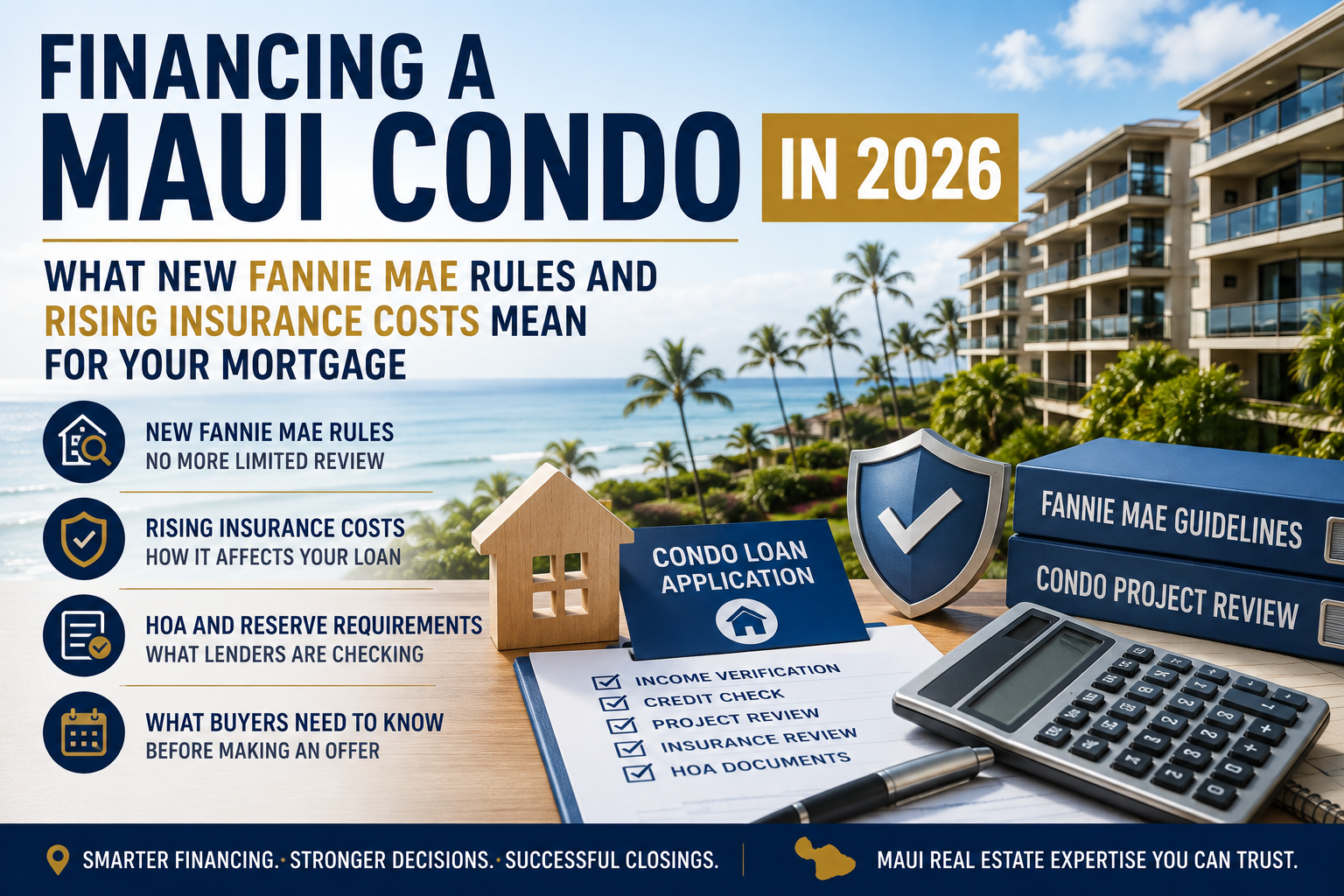
Can You Finance a Maui Condo in 2026? New Lending Rules Buyers Need to Know
Updated October 16, 2026 | By Benjamin Finnerty
Yes, you can still finance a Maui condominium in 2026. But getting approved for a mortgage involves more than qualifying as a borrower. The condominium project itself must also meet your lender's requirements.
Changes to Fannie Mae and Freddie Mac condominium lending standards, along with insurance costs and HOA financial concerns, make it especially important to investigate a building's financing eligibility before committing to a purchase.
Here's what Maui buyers need to know.
What Changed With Maui Condo Financing in 2026?
On August 3, 2026, Fannie Mae retired its Limited Review process for condominium projects. Freddie Mac also introduced changes to its condominium project review requirements in 2026.
For many conventional loans, lenders now need a more comprehensive condominium project review unless the transaction qualifies for an applicable waiver or another permitted review process.
Depending on the project, lenders may examine:
- HOA budgets and financial statements
- Reserve studies and replacement-reserve funding
- Master insurance policies
- Special assessments and major repairs
- Pending litigation
- Delinquent HOA assessments
The important distinction: A buyer can have excellent credit, sufficient income, and a substantial down payment, yet still encounter financing difficulties because of the condominium project.
What Happens to HOA Reserve Requirements in January 2027?
Another important change takes effect for applicable loan applications dated January 4, 2027, or later.
Fannie Mae is increasing the standard minimum replacement-reserve allocation from 10% to 15% of annual budgeted assessment income for projects undergoing Full Review.
For example, if a condominium association has $1 million in annual budgeted assessment income, the standard minimum reserve allocation would increase from $100,000 to $150,000.
However, qualifying reserve studies may provide an alternative way to demonstrate adequate funding.
This does not automatically mean that every Maui condominium association must increase its HOA fees by 5%. The impact depends on the association's existing budget, reserve study, funding strategy, and applicable lending requirements.
Buyer takeaway: Ask your lender whether the association's current reserve funding is likely to satisfy the requirements applicable to your loan, particularly if you expect to purchase in 2027.
Why Does Condominium Insurance Matter?
A Maui condominium's master insurance policy can affect whether a lender approves financing.
Lenders may need to verify coverage amounts, policy terms, deductibles, and other requirements. Insurance expenses can also influence HOA budgets and monthly ownership costs.
Before purchasing, buyers should understand whether the association has adequate coverage under their lender's requirements and whether insurance expenses could create financial pressure on the association.
An HOA having insurance does not necessarily mean that every loan program will accept the coverage.
What Makes a Maui Condo Difficult to Finance?
Potential issues include insufficient reserve funding, significant deferred maintenance, unresolved critical repairs, inadequate insurance, excessive HOA delinquencies, and certain types of litigation.
Some condominium projects may also encounter restrictions related to hotel-like operations or other project characteristics.
These issues require individual evaluation. A special assessment, for example, does not automatically make a project ineligible, but the underlying reason for the assessment and its status can matter.
A condo being difficult to finance through one conventional loan program does not necessarily mean that no financing is available. Portfolio lenders and other loan programs may have different requirements, rates, and terms.
How Can You Find Out Whether a Specific Maui Condo Is Financeable?
Before making an offer, consider these five steps.
1. Identify the condominium project. Provide your lender with the property's address and condominium association name.
2. Request an early project eligibility review. Ask whether the lender has recently financed units in the complex and what project documentation will be required. A previous approval is useful information, not a guarantee.
3. Review the HOA's financial condition. Obtain available budgets, reserve studies, assessment information, and relevant financial records.
4. Investigate insurance and repairs. Ask about master insurance coverage, significant maintenance projects, outstanding repairs, and pending assessments.
5. Protect your financing contingency. Work with your REALTOR® and lender to establish appropriate contract timelines, allowing sufficient time for project review and underwriting.
A lender's final determination depends on the specific loan program, borrower, project, documentation, and applicable guidelines.
Does Bill 9 Affect Condo Financing on Maui?
Maui's short-term rental regulations are a separate issue from Fannie Mae's condominium project standards, but both may be relevant when evaluating a purchase.
Buyers considering vacation-rental condominiums should independently verify zoning, permitted uses, applicable restrictions, and any regulatory changes affecting the property.
Do not assume that a condominium's historical vacation-rental use guarantees future permission or conventional financing eligibility.
Is Buying a Maui Condo Still Worth Considering?
Financing requirements should be part of your purchasing decision, not necessarily a reason to avoid condominiums.
Understanding project eligibility early can help buyers avoid unnecessary expenses, evaluate competing properties more effectively, and reduce the risk of financing surprises during escrow.
A well-informed purchase begins with understanding both the individual unit and the condominium association behind it.
Considering a Maui Condo? Contact Benjamin.
Have a particular Maui condominium complex in mind?
Send me the complex name or property address. I'll help you identify the key financing questions, relevant HOA documents, and next steps to discuss with your lender before moving forward.
Call or text: 808-481-9748
Email: benjamin@the808team.com
Website: benjamin.the808team.com
Benjamin Finnerty | REALTOR® RS-83812
Director of Sales, The 808 Team
Keller Williams Realty Maui | RB-21851
This article provides general educational information, not lending, legal, tax, insurance, or financial advice. Financing eligibility is determined by the lender under the applicable loan program and current guidelines. Buyers should consult appropriately qualified professionals about their specific circumstances.
中文摘要
2026年仍可为毛伊岛公寓办理贷款,但审批不仅取决于借款人资质,公寓项目本身也必须符合贷款机构的要求。贷款机构可能审查公寓协会(HOA)预算与财务报表、储备金研究与储备金提存、总保险单、特别评估与大修计划、未决诉讼以及欠缴的协会费用。文章还提到2027年1月起HOA储备金规定的变化,以及公寓保险对贷款审批的重要性。买家应在出价前向贷款机构确认该项目是否符合当前放贷标准。Benjamin Finnerty 是毛伊岛的 REALTOR®,是南毛伊地区的房产专家,服务范围遍及全岛。
普通话服务
Benjamin Finnerty 精通普通话,可以用中文为您解答在毛伊岛购房的各类问题,包括公寓协会文件、贷款、短租法规以及购房流程。
联系方式:电话/短信 808-481-9748,电子邮件 benjamin@the808team.com

The 808 Team Maui
| The 808 Team | Keller Williams Realty Maui
or another way