
Categories
Buying Real Estate in MauiPublished August 23, 2026
Can Non-Residents Buy Property in Hawaii? What Mainland and International Buyers Need to Know

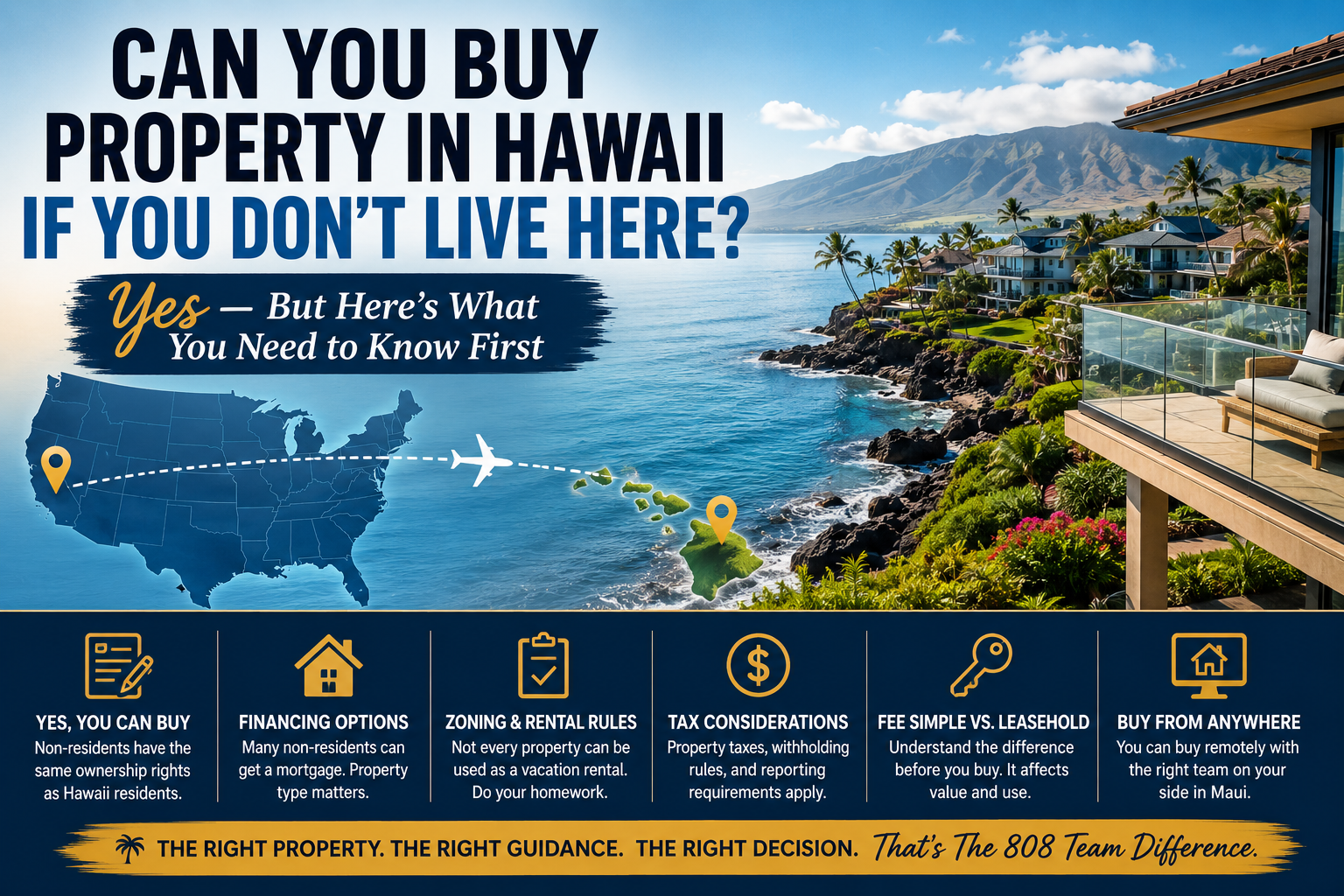
If you're wondering whether you can buy property in Hawaii without living there, the short answer is yes. Non-residents can legally buy real estate in Hawaii, and that includes mainland U.S. buyers as well as many international buyers.
What surprises most people is not whether they can buy, but how different the process can be once they start looking closely at financing, zoning, taxes, rental rules, and ownership structure. If you want to avoid expensive mistakes, you need to understand those details before you make an offer.
Key Takeaways
• Yes, non-residents can buy property in Hawaii.
• There are no Hawaii residency requirements for buying real estate.
• U.S. citizens do not need special permits to purchase property in Hawaii.
• Foreign buyers can often purchase as well, but may face different financing, tax reporting, and withholding rules.
• Non-residents generally have the same ownership rights and title protections as local buyers.
• Hawaii uses an escrow and title process, similar in principle to other states, but local rules and property types matter.
• Property taxes vary significantly based on how the property is classified and used.
• You need to understand fee simple vs. leasehold before buying.
• Short-term rental rules are strict, especially on Maui, and many homes cannot legally be vacation rented.
• The smartest question is not just, “Can I buy?” It’s “What type of property fits my long-term goals?”
What does it mean to buy property in Hawaii as a non-resident?
Buying property in Hawaii as a non-resident means you purchase real estate in the state without living there full-time or being a Hawaii resident. You can buy a home, condo, second home, retirement property, or investment property depending on the property’s legal use and your goals.
In most cases, your residency status does not limit your basic right to own property in Hawaii.
Can non-residents legally buy property in Hawaii?
Yes. If you live in California, Texas, Florida, or almost anywhere else in the United States, you can legally purchase property in Hawaii.
There is no rule saying you must live in Hawaii first. There is also no requirement that you become a Hawaii resident in order to own real estate there.
That applies to many common buying scenarios, including:
• Vacation homes
• Second homes
• Retirement properties
• Investment condos
• Luxury oceanfront properties
• Future primary residences
Your ownership rights are generally the same as someone already living in Hawaii. Title is protected the same way, and the closing process usually runs through escrow and a title company.
Can foreign buyers purchase real estate in Hawaii?
Yes, many foreign nationals can buy property in Hawaii too.
That said, international buyers need to pay closer attention to the details. The legal ability to buy is often straightforward, but the transaction itself may involve added complexity around:
• Financing options
• Tax reporting
• Withholding requirements
• Currency movement
• Coordination with accountants and legal advisors
If you live outside the United States, it is especially important to work with professionals who understand international real estate transactions. A buyer from Canada, for example, may face different lending and tax considerations than a buyer from California.
Do you have to live in Hawaii to own property there?
No. You do not need to live in Hawaii to own property in Hawaii.
Many buyers only visit once or twice a year. Some buy years before they plan to retire there. Others buy now, rent the property out in a permitted way, build equity, and move later.
This is one of the biggest reasons Hawaii continues to attract mainland buyers. Ownership can be part lifestyle decision, part long-term financial strategy, or both.
Can non-residents get a mortgage in Hawaii?
Yes, many non-residents can get a mortgage to buy Hawaii real estate.
The lending process may feel similar to a mainland purchase, but property type matters a lot. Some homes and condos are easy to finance. Others, especially certain vacation-rental-style condos or condotels, can come with added lending requirements.
What to do first
Get pre-approved before you start shopping.
That gives you:
• A realistic budget
• Better clarity on loan options
• Stronger offers when you find the right property
• Early warning if a lender has concerns about the property type
A practical rule
Choose a lender familiar with Hawaii properties whenever possible.
Many mainland lenders do fine on standard purchases, but Hawaii-specific issues can create problems fast. Local lenders and local agents usually understand:
• Zoning restrictions
• Vacation rental classifications
• HOA document requirements
• Flood zones
• Shoreline regulations
• Insurance challenges
That local knowledge can save you time, money, and major frustration.
What makes buying property in Hawaii different?
The biggest differences usually come down to taxes, zoning, rental restrictions, and ownership structure.
This is where many non-resident buyers get caught off guard.
How do property taxes work for non-residents in Hawaii?
Property taxes in Hawaii can be very different from what buyers expect on the mainland.
On Maui, for example, tax rates can vary depending on how the property is classified. Common categories may include:
• Owner-occupied homes
• Second homes
• Short-term vacation rentals
• Long-term rentals
• Commercial properties
An owner-occupied home may qualify for a $300,000 exemption and the lowest rate, while a second home or vacation rental may be taxed at a much higher rate.
Why this matters
The way a property is classified can dramatically affect your annual carrying costs.
Two properties with similar purchase prices can have very different tax bills depending on use. If you're buying as an investor, second-home owner, or future retiree, you need to verify the current classification and understand what happens if your use changes.
What is the difference between fee simple and leasehold in Hawaii?
This is one of the most important concepts for Hawaii buyers.
Fee simple
Fee simple means you own the property and the land beneath it.
This is the ownership structure most buyers expect and the one most people are looking for when they purchase in Hawaii.
Leasehold
Leasehold means you own the improvements, such as the house or condo, but you lease the land for a specific period of time.
Leasehold properties are often less expensive upfront, which makes them attractive to some buyers. But lower price does not automatically mean better deal.
Decision rule
• Choose fee simple if you want long-term ownership clarity and broad resale appeal.
• Consider leasehold only if you fully understand the lease terms, timing, costs, and exit risks.
If you do not understand the difference before making an offer, you can make a very expensive mistake.
Can you use a Hawaii property as a vacation rental?
Sometimes, but only if the property is legally allowed to be used that way.
This is where buyers need to be extremely careful, especially on Maui.
Short-term vacation rentals are not something you can assume. Whether a property can be rented short-term depends on zoning and county classification. In many cases, legal vacation rentals are limited to specific condo projects or properly designated properties.
A critical rule
If you buy a house and assume you can vacation rent it, you may be wrong.
On Maui, illegal short-term rentals can trigger severe penalties. In some cases, fines can reach $10,000 per day.
What to verify before buying an investment property
Ask these questions before you go under contract:
• Is short-term rental use legally allowed?
• What is the current zoning?
• Is the property in a hotel, apartment, or residential district?
• Has the property historically operated as a legal vacation rental?
• Are there HOA restrictions beyond county rules?
• What rental term is allowed?
On Maui, long-term rental generally means six months or more. That is very different from using a property as a nightly or weekly vacation rental.
Never buy an investment property based on assumptions about rental income. Verify the legal use first.
Do you need to travel to Hawaii to buy property?
No. In many cases, you can buy property in Hawaii remotely.
Technology has made long-distance buying much easier. Buyers now use video calls, virtual showings, electronic signatures, and digital document systems to complete much of the process from anywhere.
Remote buying can include:
• Virtual tours
• Video walkthroughs
• Electronic signatures
• Remote escrow coordination
• Document review from your home state or country
Many buyers close without seeing the property in person until after closing.
Should you visit first?
If you can visit before you buy, I recommend it. There is no substitute for seeing the property, neighborhood, traffic flow, surroundings, and overall feel in person.
But it is not always required, especially for experienced buyers with a trusted local team.
What should non-resident buyers do before making an offer?
If you only do a few things before buying Hawaii real estate, do these first:
• Get pre-approved
• Clarify your long-term goal
• Confirm the property's legal use
• Verify tax classification
• Understand fee simple vs. leasehold
• Review HOA rules and insurance issues
• Work with a local lender and local real estate professional
That last point matters more than most buyers realize.
The goal is not just to find a property. The goal is to make sure you are buying the right property for your intended use.
Common mistakes non-resident buyers make
1. Assuming residency is required
It isn’t. Many buyers delay their search because they think they need to move first.
2. Assuming every property can be vacation rented
This is one of the most expensive assumptions you can make in Hawaii.
3. Ignoring property tax classification
Purchase price is only part of the cost. Annual taxes can vary widely based on use.
4. Not understanding leasehold
A lower list price can hide a very different ownership situation.
5. Using the wrong lender
A lender unfamiliar with Hawaii property types can slow down or derail a transaction.
6. Focusing on the property before the strategy
You will make better decisions when you first define your goal:
• Personal use
• Retirement
• Second home
• Long-term rental
• Legal short-term rental
• Future relocation
When the strategy is clear, the right property becomes much easier to identify.
FAQ
Can I buy property in Hawaii if I live on the mainland?
Yes. Mainland buyers can legally purchase real estate in Hawaii with no Hawaii residency requirement.
Do I need a special permit to buy property in Hawaii?
U.S. citizens generally do not need a special permit to buy property in Hawaii.
Can Canadians buy property in Hawaii?
Yes, Canadians and other foreign nationals can often buy property in Hawaii, but they may face different financing and tax rules.
Can I buy a house in Hawaii and use it as an Airbnb?
Not automatically. Short-term rental use depends on zoning, county classification, and sometimes HOA rules. Never assume a house can be legally used as a vacation rental.
Is leasehold property a bad idea?
Not always, but it is a very different form of ownership. It can work in the right situation, but only if you understand the lease terms and long-term implications.
Do I need to fly to Hawaii to close?
Usually not. Many parts of the transaction can be handled remotely through virtual tours, digital communication, and electronic signatures.
Next Steps for Buying Hawaii Property as a Non-Resident
If you're serious about buying, keep the process simple:
• Decide exactly what you want the property to do for you
• Get financing lined up early
• Narrow your search by legal use, not just by price or view
• Double-check taxes, zoning, and ownership structure
• Build a local team before you make an offer
Conclusion
Yes, non-residents can buy property in Hawaii. That part is easy.
The real work is making sure the property matches your goals, financing, tax expectations, and intended use. If you understand the rules around zoning, rentals, taxes, and ownership type before you buy, you put yourself in a much stronger position to make a smart purchase.
If you're buying from the mainland or internationally, the best move is to start with strategy first. Once you know whether you want a second home, retirement property, long-term rental, or legal vacation rental, the right property becomes a lot easier to find.
Thinking About Buying Property in Maui From the Mainland?
You don't have to live in Hawaii to own a piece of Maui—but buying the right property is about much more than finding a great view.
Zoning, vacation-rental rules, property taxes, HOA financials, insurance, financing, and whether a property is fee simple or leasehold can completely change whether a property makes sense for you.
That's where having someone on Maui working for you matters.
I help mainland and out-of-state buyers navigate the Maui market from the first conversation through closing. Whether you're looking for a second home, retirement property, investment, or legal vacation rental, we'll start with your goals and narrow the search to properties that actually fit them.
And if you can't be on Maui? That's okay. We can handle virtual showings, video walkthroughs, inspections, negotiations, and much of the buying process remotely.

Todd Hudson | The 808 Team
Keller Williams Realty Maui
📞 808-344-3584
✉️ Todd@the808team.com
Thinking about buying on Maui? Reach out to me before you start your search. Let's build the strategy first, then find the property.

The 808 Team Maui
| The 808 Team | Keller Williams Realty Maui
or another way